

Fake News, Fake Views, Fake Stuff…Does anyone care?

I do, and I am quite sure most do.

The issue is not about caring; it is more about doing. By definition, Fake News is still News as the identification of it alone becomes the story. The UK Government has decided in its infinite wisdom that school kids should be taught about identifying Fake News. How and by whom? Even the sharpest brains can be fooled into believing something is true when it turns out to be fake. Modern ( and historic) finances are littered by Ponzi-type schemes.

Fake News Through The Ages

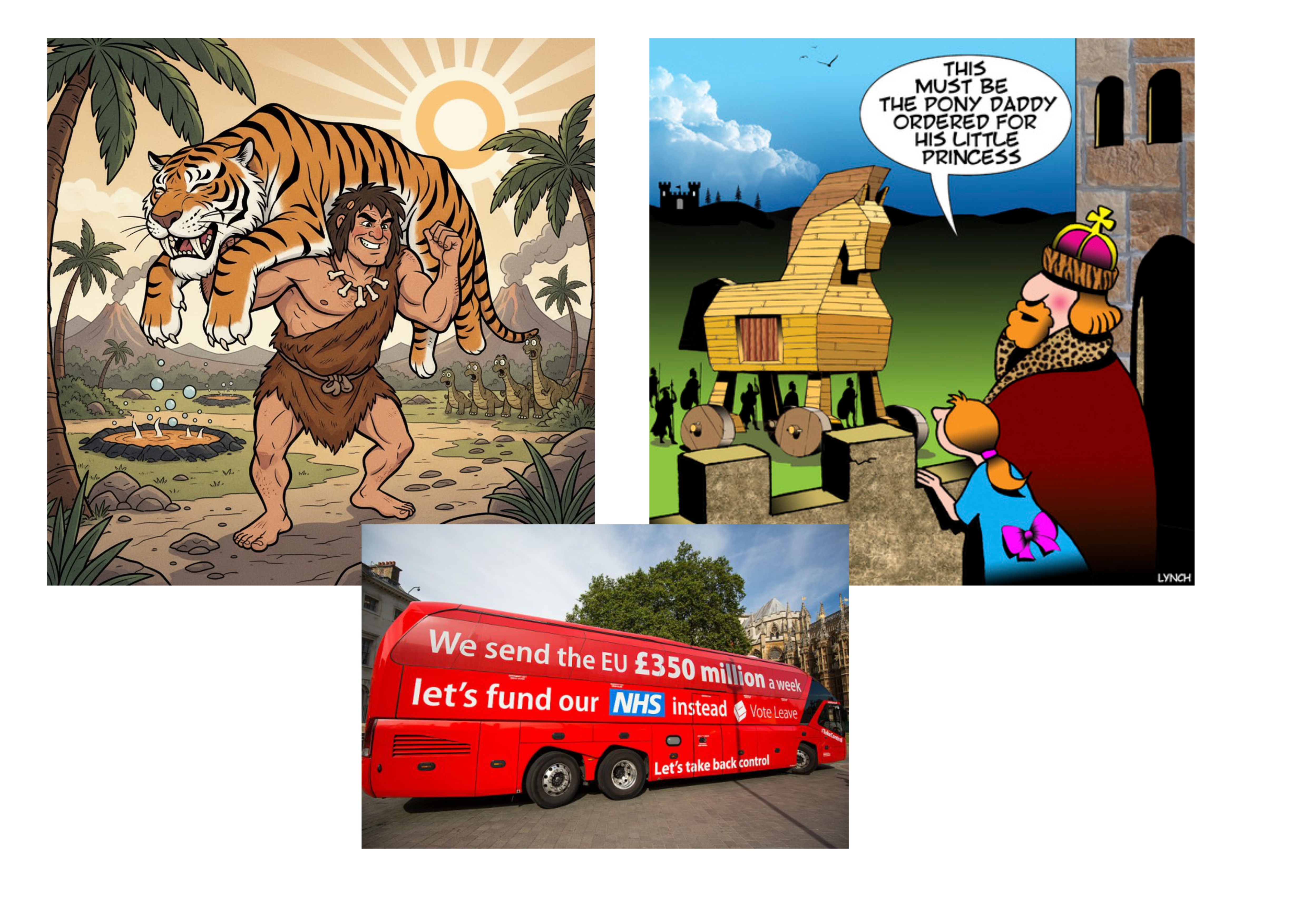
Since Homo Sapiens stood up on two legs, they have been spreading fake news. Sitting around the fireside telling all of their amazing feats of killing ginormous Sabre-Toothed Tigers with their bare hands. The Greeks sending what appeared to be a Gift from the Gods to the Gates of Troy, without telling the whole story that it was ram jam full of Ancient Greek special forces. Telling the British electorate on Brexit that the £350 million each week saved from EU contributions could be used for the NHS. Or that was how it was interpreted. All three illustrate how difficult it can be in deciding what is fake and what is not.

So, Fake News has been disseminating from early human speech (and probably before). What is happening now is that the means of spreading it are much more effective. But ’tis not that about which I wish to post. It is Fake Product. Not for the first time, yet I am constantly amazed at how much of it is clear for all to see.

Fake product takes varying disguises.

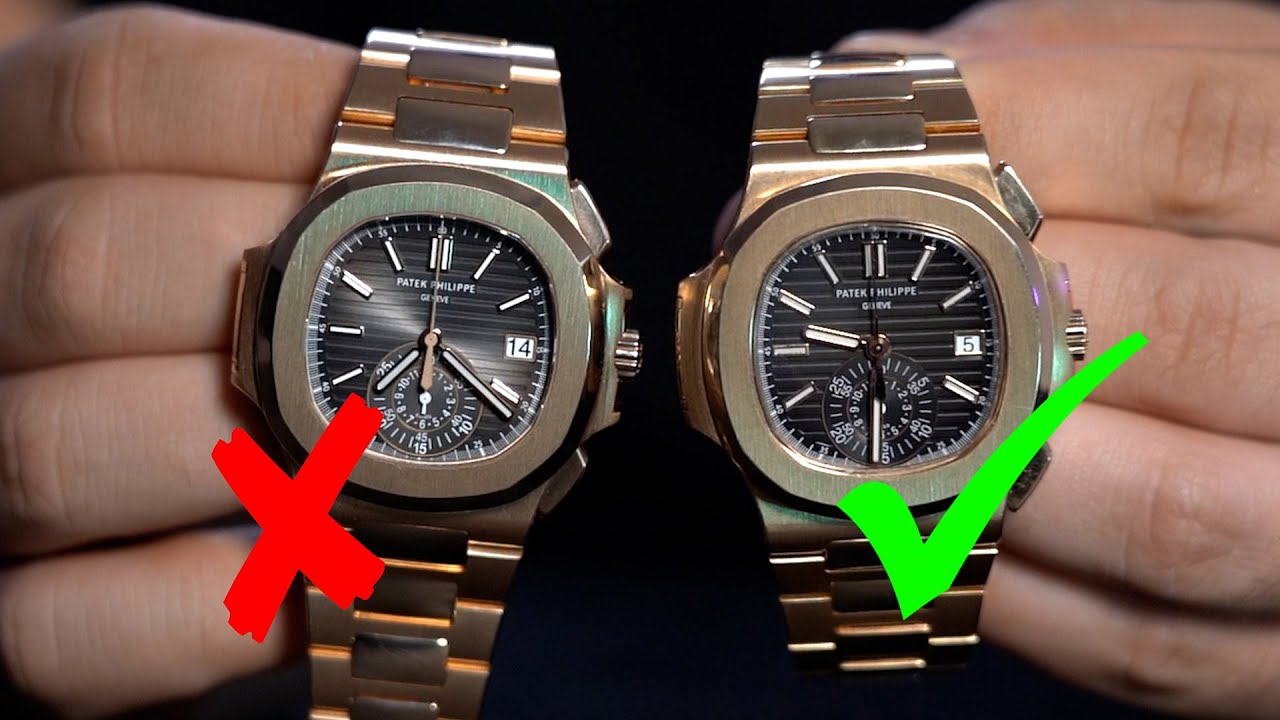
When Watches are being made and sold for tens of thousands of pounds( even millions) is it of any surprise to anyone that factories also churn out thousands of fakes that sell for a fraction of the price. These are proper illegal fakes. To the naked eye it is not easy to spot the difference. I know, as in years past, I have bought such copies (purely in the interest of research, of course ). I suspect that the makers of the Patek Phillipe are not that bothered. Their target market is never going to buy a fake. Those who buy fakes could never buy the real thing.

However, if you were looking to buy an Iphone for say £1000 and there was an Aphone that looked and performed in exactly the same way, at £400 you would be very tempted and it would quite clearly impact Apple’s Business. And does……

There dozens of pages and videos on how to spot a fake iPhone.

On a much lower level, in an area of personal interest, are the marketplaces where some sellers sail very close to the wind.

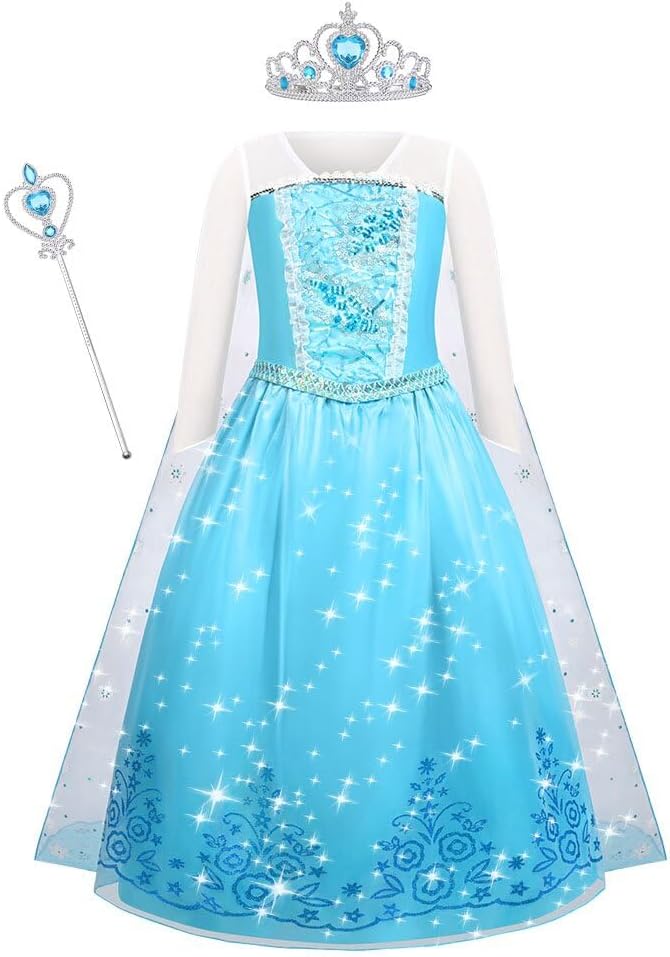
This is taken from a seller on Amazon. It is described as Elsa Princess Costume. It does not mention Disney but for all intents and purposes, it is a knock off. The Vendor is based in China (Co. Name SHENZHENSHIYOULATESHIYEYOUXIANGONGSI) . Yes, it is real and registered by HMRC. Are they breaking any laws?

On a less severe note but equally a pain in the bum, is the practice of taking a lookey-likey, placing the product on an existing listing by a well-known brand. It does not say it is the same product, but looks very similar and is often a lot cheaper. Whilst it is not actually a criminal offence but is certainly against the policy of someone like Amazon. It is very difficult to monitor (even for Amazon) but needs to be done by the brand owner where possible .

The bottom line is that fake product is such big business and so profitable that even when the perpetrators are caught, there is always someone else to replace them. Bit like drug dealing, except the shipping companies will probably not get blown to smithereens by American missiles! Of course the fake items purchased on online marketplaces are unlikely to cause damage to the health of the nation. Unless they are cosmetics, medicines, knives, electrical goods, paints……

One would think that that Big Tech would have more control over this …..

Number of Products on Amazon

Even for them, it is a tough ask. And we must not forget Bricks and mortar outlets will also have fake products. Some knowingly, some not.

A Fake is one thing but a dangerous fake is another. Regrettably, there is a huge range of stuff where the the Fake is potentially very dangerous cosmetics, medicines, knives, electrical goods, paint, toys, and party items to name but a few. According to the consumer magazine ‘Which?’ it estimated that nearly 70% of cosmetics purchased online are fake.

French Authorities have recently published a report saying they have stopped over 11 million toy items at the border from entering the marketplace. They are a mix of counterfeits, product failing to meet safety standards.

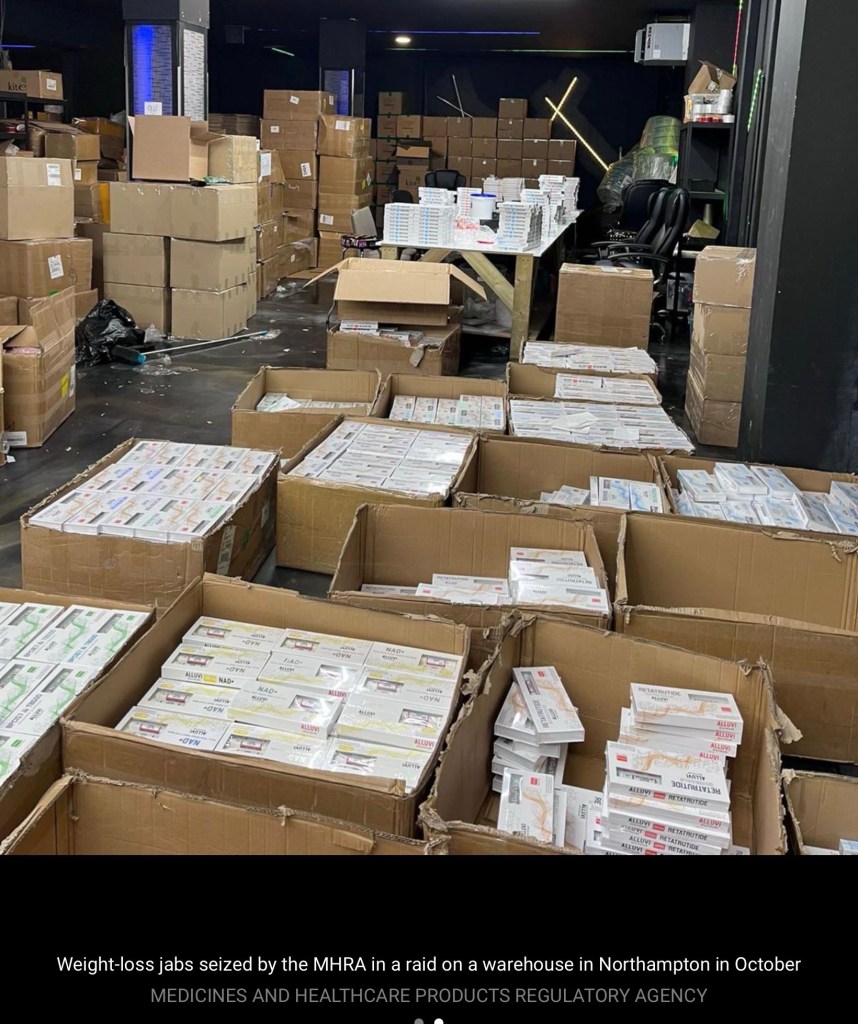
Fake Drugs -The Times 15th December 2025

Just because an item is cheap, looks ok and does the job doesn’t make it right.

According to the OECD the global market for fake products was just under $500 billion in 2021. Accounting for 2.3% of world trade. It will never be eradicated but it does not mean it should be encouraged. If a deal looks too good and invariably it is . And don’t think by buying it does no one any harm . It does. Someone out there in the chain gets hurt in one way or another .

Some will say “the likes of Apple make bucket loads of money anyway…so what”. Well Apple do make loads of dosh. But that doesn’t make it right. If they had not taken risks years ago investing loads of dosh in the technology, we may not have had smartphone technology. Naturally, the same can be said for many highly successful operations. James Dyson staked everything he had on his belief in his development with the first bagless vacuum cleaner….

The product has been copied relentlessly since it became a market success. This includes the Hoover Company who were successfuly sued for copying a key aspect of his technology. Dyson became and remains a multi-billionaire.

Little will change despite many Governments claiming they will make strenuous efforts to clamp down on such nefarious activity. Bit like drug dealers, the rewards far exceed the risks.

Whether manufacturer, importer, distributor, retailer, or consumer, we all need to take a close look at ourselves and ask ….

Am I, in any way, even in a very small way, slightly complicit?’

The Future of UK Retail is….. (Drum Roll) The Corner Shop!

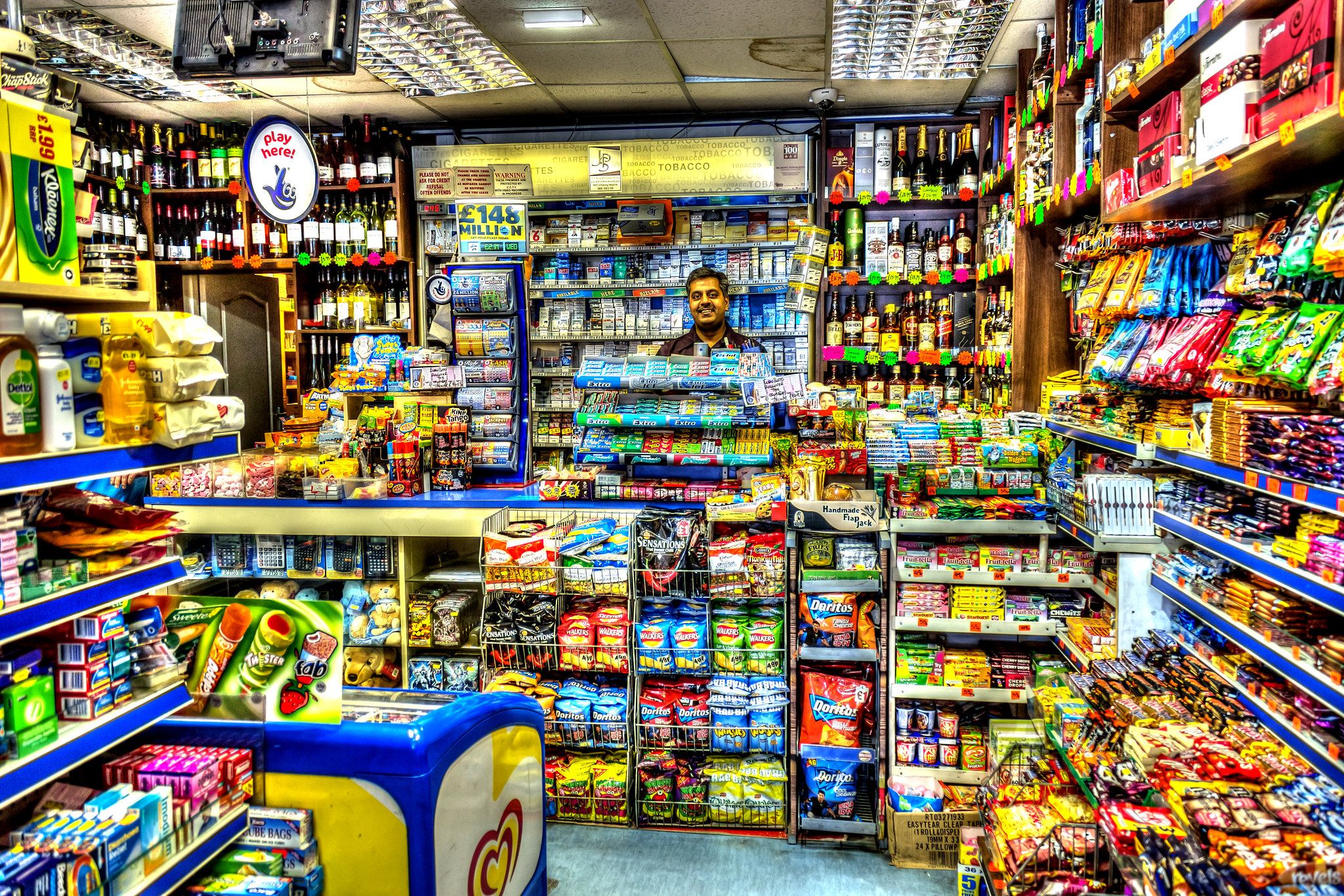
Retail Stock Maximization

Oh yes it is .

It came as a bit of a surprise to me. But then I thought about it, and it was less of a surprise. Covid, Working from Home, and a new generation (both owner and customer) have breathed a new life into this sector of retail.

I have seen the Corner Shop go through a whole gamut of changes. From the near and feared complete demise of the newsagent/cornershop in the late 1970’s early 1980s, when restrictive practices were eased on the distribution of Newspapers, and the Supermarkets started selling them. It was the local independent’s USP, and they lost it. Through to the 21st century version stuffed full of stock, open all hours, and a smile on their face.

However, there was a cultural change in the early 1980’s that probably saved the UK Corner shop. Immigration from areas such as East Africa introduced a new type of retail entrepreneur who saw opportunities for creating and developing a business within a community. By the end of the 1980’s 50% of independent corner shops owners were of Asian Origin. They were prepared to work much longer hours and where relevant seven days a week . Today some of the UK’s wealthiest families started with one small shop in the 1980’s.

I started to notice a change several years ago not in Mainland UK, but in the Republic of Ireland. Frequently travelling around the countryside, I would go into Convenience Stores to buy a drink and a sandwich. It was very noticeable how different they looked against the UK equivalents. Organised, very professional looking and well ranged, were my initial thoughts. In more recent years this crossed the Irish Sea. Not in exactly the same way , as I am not so sure that many have replicated the smart look of the Irish stores. What they have done is squeezed pints into half pint glasses. I have a number of corner/convenience stores in my locality and the range of stock they carry is quite extraordinary. Compared to local Convenience stores operated by major supermarkets, they are invariably half the size but carry probably twice the variety of product.

Clearly, it is not just about choice. As most are staffed by the owner(s), there is an additional level of service and community feel, long opening hours and the flexibility to meet local needs.

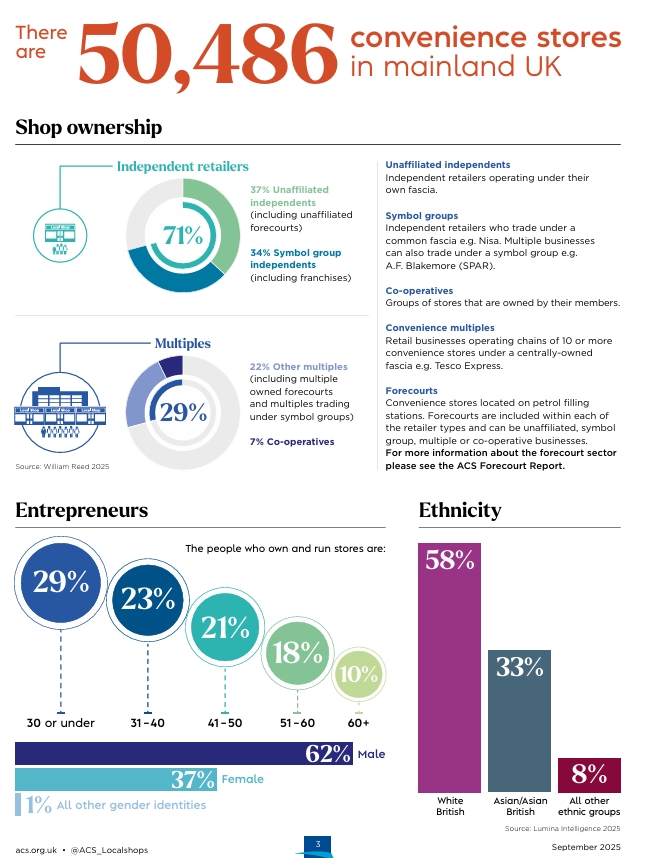
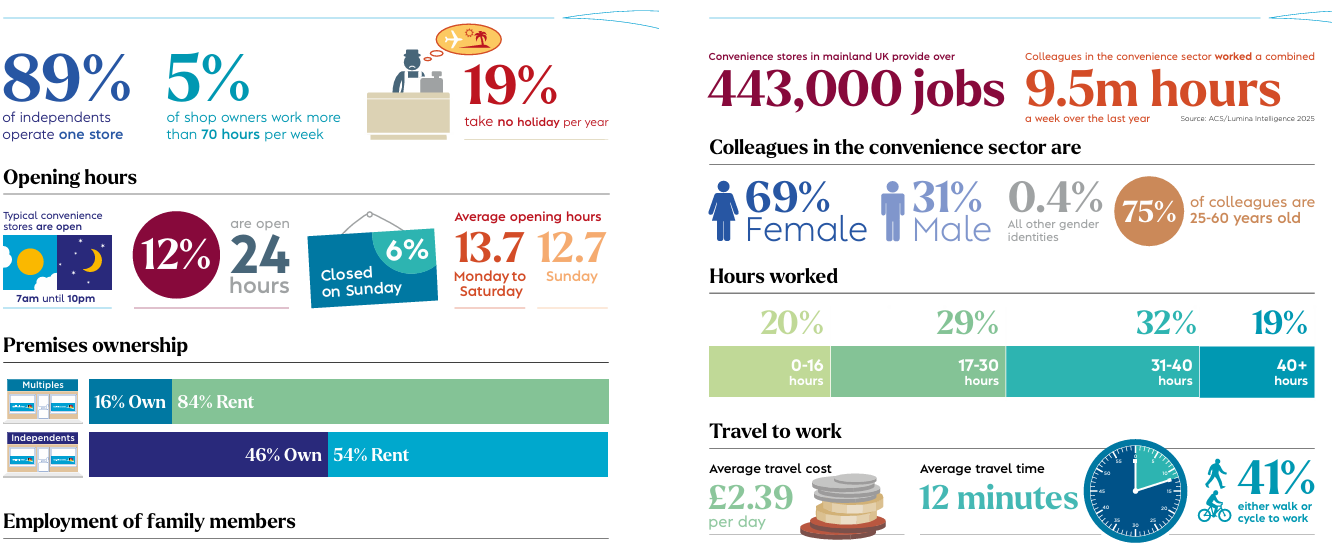
What is quite striking about the above chart is that the largest age group of entrepreneurs is the under 30 Age Group. This statistic alone is very positive , as historically, I suspect that figure would have been a lot lower. Most certainly that would be the perception.

Digging a little deeper, that revenue is fractionally down on the previous year (approximately 2%); however, these are the stats of the ACS (as above), and not all independents are members of this Association. It is also important to underline the fact that the vast majority of these retailers are grocery-based. For me, this makes these numbers even more impressive as their competition are all ‘Big Guns’. The membership of ACS includes Post Offices and Pharmacies.

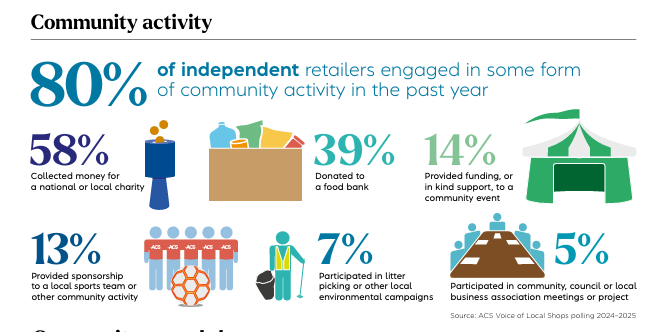
I am in danger of overloading this with 3rd party diagrams (all courtesy of ACS Local Shop Report 2025), but I am still going to do it as I think they throw up some interesting stuff.

There done it .

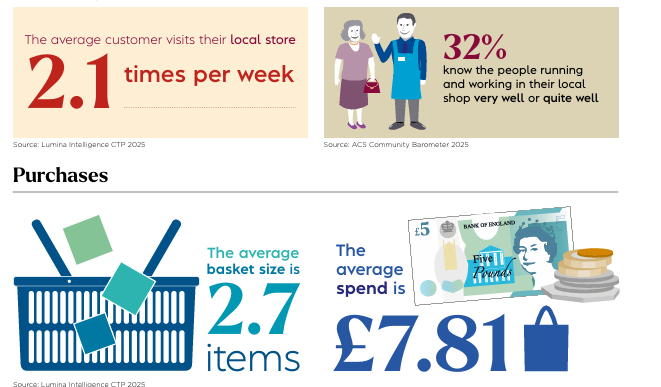
Of course, not all of it is ‘Wine & Roses’. There are major issues facing all UK retailers. With all the increased cost pressures on Retail Businesses, the last diagram illustrates the average basket size and spend. Neither of which look great.

With an average spend under £8 it is going to be tough to make any money. They are clearly not selling many packs of fags (average UK price of 20 king size=£16.60 –ONS Jan 25 ). A good thing for the Nations Health but not for the Retailer’s till! Even with a hefty margin, it is not easy making any money from an average take of £8 even if it is only 3 items. Yet if that customer visits the shop twice a week, as per the stats that equates to £800 per year per customer. The total average turnover is just under £1 million. The average net margin in Grocery is under 2%. However, this includes the multiples and does not include non-foods. Clearly there is going to be a huge variety in the Independent sector with both turnover and margin.

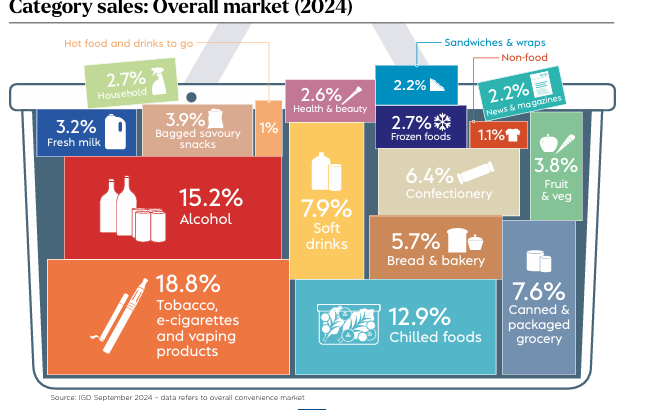
The diagram above indicates that from a point of view of margin, there are areas that have reasonable margins but are not especially well represented in the shop profile. The one that sticks out is the tobacco and vapes. Being the largest percentage, you would expect to see it in the average take. But then I have never been a retailer!

Yes, it is tough for all retail, yet there is some comfort in seeing an area of retail that twenty-five years ago seemed doomed actually growing. More importantly, much to my surprise, attracting a younger generation to participate. This is a generation that, for the most part, grew up with the explosion of the internet and experienced the birth of online shopping.

Footnote

Having looked through loads of different types of research and reports over the years, the Association of Convenience Stores should receive a round of applause for the quality of their reports. I cannot attest to the quality of data but with access to such a large membership, it has to be pretty reliable. It is the presentation that stands out. Research and Reports are created every minute of the day, everywhere in the world by a vast variety of ‘expert‘ organisations. So many are jammed full of useful data and analytics but they are often hidden by either complex jargon or unnecessary padding. In a market where the hours are long ( small independents) there is neither the time nor the desire to digest the relevant information. if bundled into dreary and forbidding reports. The ACS seems to have got it right.

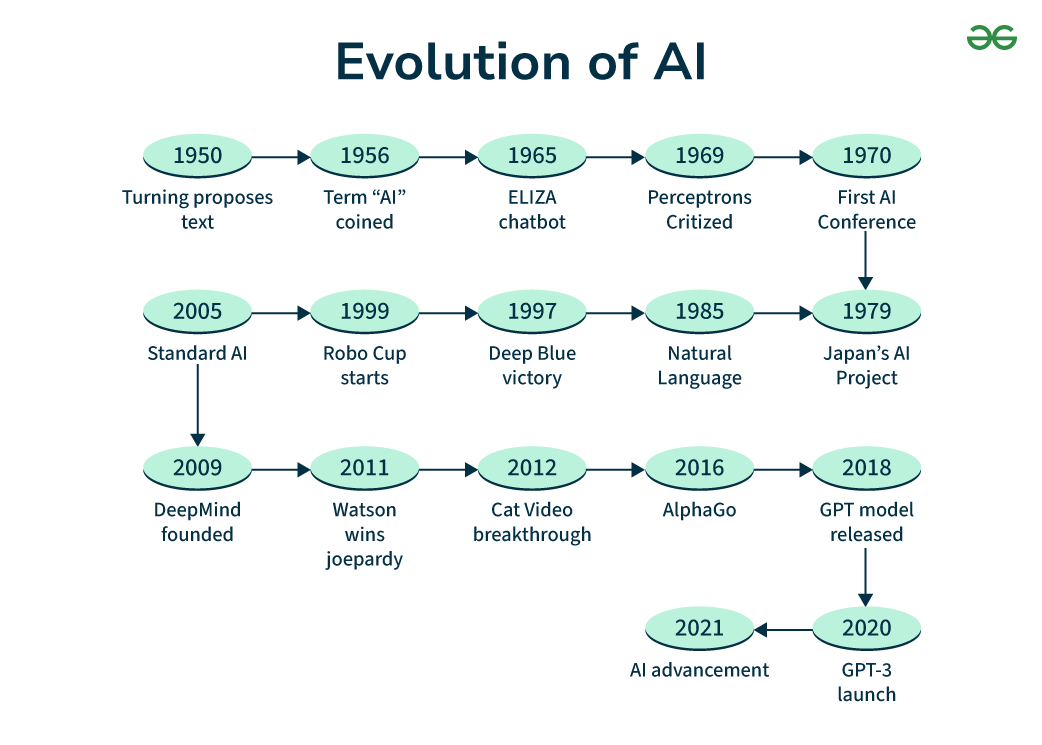
AI… Retail Panacea or just Aye Aye Pigs may Fly?

Artificial Intelligence within the retail environment is nothing new . Amazon has been using it since the early 2000’s with its recommendation engine, You bought this so you maybe be interested in this .

Prior to that (1950’s)it was called Human Intelligence. In other words, you walked into the shop and the shop owner would say ….

A somewhat more personal approach, but is it enough anymore?

Clearly for Online retailers it is not even an option. Even it were, that is not really what the future of AI is about. By definition Artificial Learning is created by machine learning. Within Retail it can cover logistics, stock control, analytics, costings, consumer behaviour, anti fraud and that’s just the start.

I have my pet hates:

  • Bots. Even with major organisations such as Banks, telelcommuciations companies, big Retailers, they are crap. Invariably, they ask you a lot of questions, many of which are irrelevant and then they say we cant answer that, we will pass you over to an operator. Then the operator asks you exactly the same questions. What benefit is that to the consumer apart from annoying the pants off them?
  • Website search functions. They are next to useless. Unless you know exactly what you are searching for, they will say no result or give you a list of products which bear no resemblance whatsoever, to your search. This is despite that there are supposed to be some very sophisticated AI tools available that eliminate those issues. One such tool is being used by a major outdoor and sports equipment. I tried it out and it returned over 6,700 products, which was sort of impressive, but amongst the first ten items, six had nothing to do with my search.

We must not use these ‘teething issues’ to distract from AI is here to stay and it has some extraordinary potential even for the smallest business.

Whatever your business, there are AI benefits that should not be ignored. Perhaps the biggest simple explanation is that there are resources a small independent business can access at a cost that previously would have been prohibitive and now are more than affordable.

So what are these extraordinary benefits ….

The list is endless. This is just a very general idea of some of the possibilities to prompt ( human prompt that is ) for the independent business to take the time to look .

It would be very easy to get into detail (I mean very low-level detail), as I don’t think it would be of much help. The point is to look at it. It is not going away, and just as important is that your competitors will be (looking that is).Most of us (I think) will have used it to play with or write a letter to get off a parking fine. Maybe plan a holiday.

Holidays are a very good example of how it is starting to happen in a useful and immediate manner. Apps are being developed whereby instead of trawling through various travel websites, going through drop-down menus all your preferences ( in some cases not being asked ALL) and still not finding excatly what you looking for. By typing in all your requirements, needs, and wishes, locations, best time to go , budget etc into one place, and getting a more personalized response. Some will say Google does the same thing. Not really, but even there you now get an AI response. The same is happening with House buying.

Let it not be said all is perfect. Far from it. From my own personal experience, AI can throw up some outrageous results that bear no resemblance to what you are asking.

AI prompts to get started 

There are loads of concerns about AI. Least of all loss of jobs. But there was with the printing press, spinning jenny, steam engines, combustion engines, telephones, radios, televisions, computers, fax machines, mobile phones ……..Society adapts and develops. As a business, we all have to do the same. There will be some pain. As most medics will tell you, the best way to avoid pain is to get ahead of it.

There is no profit to be gained from either fighting it or ignoring it. Embrace while you can.

Party Games or Toys & Games?

It has always been a mystery as to why the UK (and Eire) market for Party never matches up to that of toys?

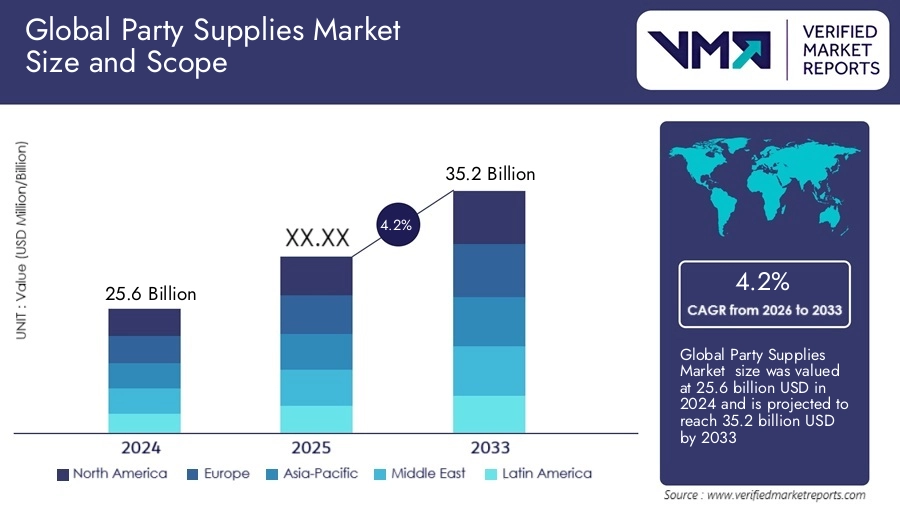
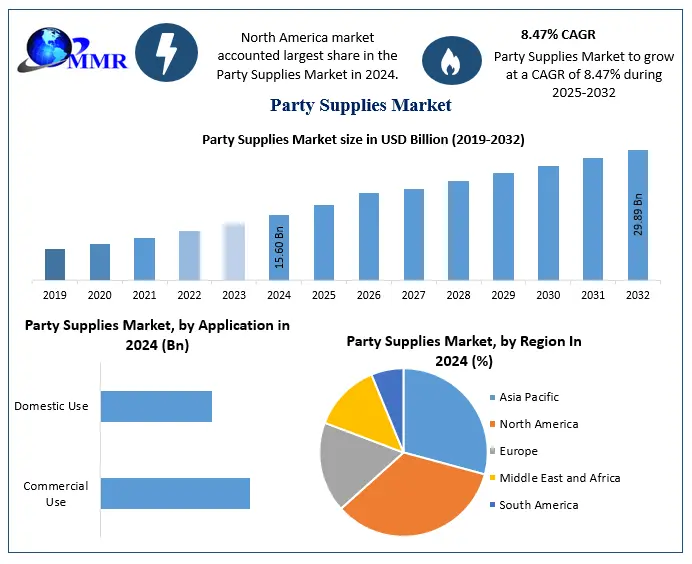
Without paying a heap of dough for some very dubious market research, there is no real indication of what the size of the Party Market is. Why doubtful, when I haven’t commissioned or read one (well, at least not for many years)? The beginning of a report by a company called Global Data, should wave red flags at anyone who knows anything about the U.K. retail Party market.

The first point is complete and utter tosh. Apart from perhaps balloons, there would be no question (and I think this is true of all Europe ), there has been a decrease in consumer purchases of partyware, most especially, Partyware disposables.

As far as the second point, would you pay for research that told you Birthdays are a key occasion for partyware purchases?

As for the chart, well, that is about as believable as the next one. There is clearly no corroboration.

There would be a lot of players in the UK marketplace who would be delighted if they thought this was possible.

I know there is a lot more systematic collation of statistics within the UK Toy market. For 2024 it was estimated at just over £4 billion (Kasia Davies- Non food specialist researcher of Statista Jan 2025).

Consequently, one can be very confident that the Toy market is much larger than that of the Party Market. I have always found this to be slightly puzzling if only for one very simple reason. The Toy Market (excepting Games) is limited to a small age group within any population and very much focused on the Christmas period (UK), with birthdays coming in a distant (I think) second place. Whereas Party encompasses the entire population as potential customers. It has its peak, that is Halloween (Carnival in parts of Europe), yet virtually every other celebratory event can involve party products of some form or other.

In 1981 in Amersham(UK) Catherine and Gary Grant established The Entertainer, an independent Toy Retailer. Today, 2025, there are now 166 branches, in addition to potentially 2000 (by the end of 2025) further toy sections within the Tesco Supermarket chain. This is despite the downfall of UK Independent toy stores during that time and the rise and fall of Toys R US. There is more. Smyths is an Irish operation with 21 superstores in Eire and over 130 more in the UK with a further 150 throughout Europe.

Party, as Sinéad O’Connor once sang Nothing Compares….To Party (no, she didn’t sing that).

The largest chain in Party was 40 stores operated by The Greeting Card Retailer called Birthdays . The Stores were called Pure Party . They lasted about 7-8 years, closing down in about 2009 when struggling Birthdays was sold to Clintons, who eventually went bust themselves. Prior to that was the American Franchise Partyland who maxed out at 12. Whilst they have flourished elsewhere, they were doomed in the UK . For a short while, there was a small chain of 10-12 stores called Party Magic, between 2013/16. They, eventually, went the same way.

There are some very key differences in selling Toys and Party in a Retail store environment.

  • A consumer generally knows what to look for in a Toy Store. In a Party store, they don’t. They need a lot more attention. If they don’t get it(attention ie good knowledgeable customer service) in a Party Store, the likelihood is that they will walk out without buying (as thye don’t know what they want)or certainly they will buy less. With Toys, they will walk in looking for Lego(other brands are available) pick it up, and take it to the counter. This may be an oversimplification, but if you want to create a twenties theme party, the customer , more often than not, need guidance as to what that may involve.
  • Whilst margins may be lower in the Toy Industry, the average retail price point will be higher, consequently the individual cash take will be higher. Again, a generalization as I have been in a Party retailer and seen a consumer spend £800 on a first birthday party. But it also took the Store owner over an hour and half to serve this customer. Furthermore, it was going to take the store owner several hours over a weekend to set up the products on location (balloons in particular).
  • Brands play a more significant role in the Toy Market. The Toy retailer will benefit from major consumer marketing activities. Within the Party Market, this is virtually non-existent. Party Brands only play a part in the distribution chain. The consumer will have very little awareness of any of the Major Party Brands.

As the Research correctly shows, the largest Party retailers in the UK are the likes of Tescos and Card Factory. Yet this is very deceiving as they are not Party Retailers. They are big by dint of having a huge number of stores and selling, in particular, a very large number of balloons. The UK Supermarket Chain Morrisons tried incorporating a Party stand-alone within stores, but it never worked (so did Matalan some years beforehand). I have no idea why they even tried; undoubtedly, they were convinced by some dubious data given by the supplier (who incidentally no longer exists, which tells a story). There was no level of service, and it was never going to generate the level of revenue per square foot that a supermarket demands of its space.

I stand on the Cliffs of Dover and look over the Channel in wonder. There are many chains throughout Europe, most especially France.

So, what is the issue within the UK? There are underlining commercial differences. Whilst rents and local taxes tend to be lower outside the big cities, especially France, the cost to employ is very similar. France is probably higher because of their shorter working week, longer holidays and a much lower retirement age. The minimum wage is slightly lower than in the UK, but the labor laws are much more complex.

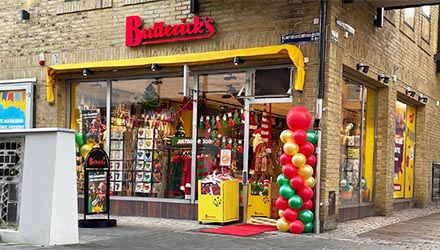
In-store ranges differ. For example, I have seen from the French party stores that I have visited, there is a lot more table decoration, disposable tableware, and, in some cases, floral decoration. Buttericks in Sweden are known for their Jokes and tricks. UK stores generally have a much more party-specific range. There are exceptions. Joke shops have Jokes! Various unclassified stores selling a range of products such as Cannabis Paraphernalia, smokers’ requisites (another quaint term), Goth products, alternative costume jewelry, and probably Steampunk. Last but not least is Party. A heady mix or just a place to get your head mixed up, nevertheless, they are called Head Shops!

Considering the number of good Party stores, whose proprietors would like to retire if they could sell their businesses ( bit of a struggle). It would be easy to think that the days of the Party retailer (High St) are doomed. I firmly believe that within a few years, there will be a new breed of retail entrepreneurs who will see that the market is underserved and will invest in new stores with a much updated view of retailing and make them Retail Destinations, which is what they need to be . Fun places to go, and most importantly, it’s about the concept of enjoying yourself in a party environment, and the consumer enjoying the experience of spending their money. Some of the UK Halloween pop-up shops have understood this. They have made their store a place to seek out and when they are there, get immersed into the atmosphere, and then most don’t mind spending a ‘few bob‘. As some retailers ( not many) are starting to understand that The Party is a great opportunity for social media and creating a ‘retail experience’

None of this has been helped by major issues with the unfortunate(or otherwise) misfortunes of some major worldwide suppliers. But the party market has a history of re-inventing itself, and I have no doubt this will happen again, but not just yet.

The Experiential Economy! What is it?

Or rather, spending money on doing stuff.

It is not a new term, as it has been around since the early 2000s. The term was first used by 2 economists back in 1998, but the theory goes back a lot further to Alvin Toffler’s book The Future Shock, published in 1970. But it is the last twenty years, when it has become a very significant part of Consumer discretionary spending.

So what sort of things are we looking at :

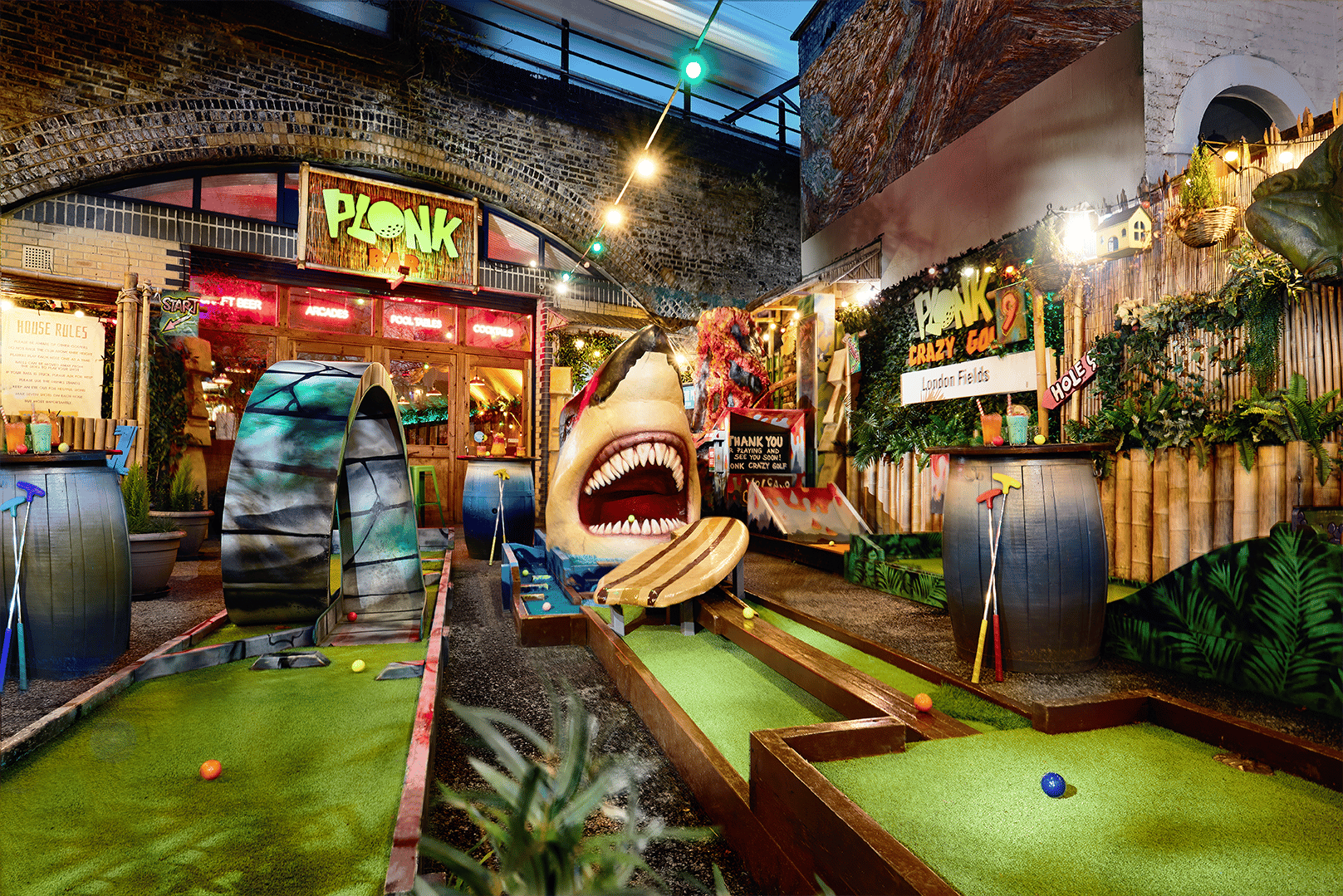
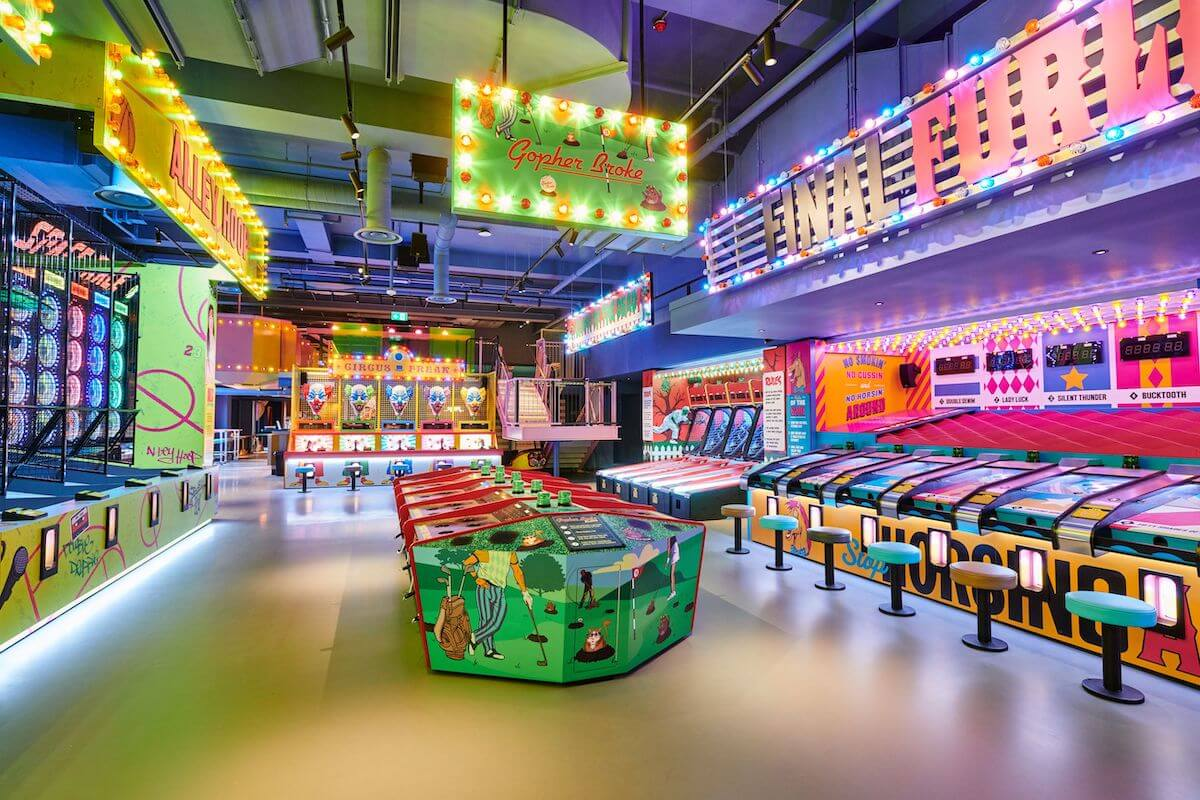
There are few large towns in Europe that do not have at least one Escape Room experience.

These are just the tip of the iceberg, as the total economy includes Concerts, holidays, events, and a bucket load of other occasions where a single or group of consumers spend more on experiencing something as opposed to just buying a product, for the primary reward of enjoyment. This has an exponential impact on consumer spending within the wider economy.

The obvious losers in this are those in Hospitality. But I think that is sort of missing the point. Every retail outlet that looks for the discretionary spend can lose out, and in many cases, probably are. Hospitality is part of the Experience Spend, or certainly should be. Yet Pubs,and restaurants in the UK are all facing tough times. It is no longer just about throwing pints down your neck or eating as much as you possibly can in the ‘all you can eat’ buffets.

If your business is not an obvious player in this market, how do you access this spend? With difficulty. Within my own marketplace of Party, it is really important that you keep well informed of any of these events that maybe occurring within your locality, as there will be opportunities to attract participants spend particularly where there is any level of dress-up involved (See below where both Glastonbury and Music concerts attract a level of dressup)

There is, often, a more deep-seated problem with independent businesses both in hospitality and retail. Many tend to be reactive and not proactive. Locally to me, there are many restaurants, a large number struggling with the lack of spend. About seven months ago, there was a new player in town. A great deal of money had been spent on refurbishing an existing operation that was not doing especially well. That was just the beginning. From Day One, it has been a roaring success.

Why so? The offering is first class, insofar as the service is top notch (much of the team is very young and inexperienced – it is about leadership and training), the food and drink are excellent, and there is a terrific atmosphere. But it does not stop there. They are constantly engaging with their client base. There are the obvious occasions, such as Mother’s Day & Father’s Day, Easter, but they pounce on every possibility. Only recently, it was apparently National Fish & Chip week. Virually every week, they give a reason (and small incentives) to visit their operation. Most of the competition will be offering great food, good service, and possibly fair prices but they are not engaging.

There is a distinct vibe amongst many; It is very tough out there. There is a cost of living crisis. The consumer is not spending. Of course, there is a lot of truth in those few words, apart from two words in particular: Not spending. They are spending, but they don’t have so much to spend . Or that can be filtered a little further, there is a chunk of the population who have less to spend and they are spending it elsewhere.

None of this is unique to the UK economy; it is reflected in most European States. There are plenty of universal challenges to Retailers of any sort. Very recently, a report in the UK illustrated that food sales were down in May. It was suggested that some of this may be due to the new weight loss drugs and the consumer dramatically altering (or being altered) their eating and drinking habits. Clearly, this will not only impact food stores but a whole chunk of hospitality. Those offering ‘all you can eat buffets‘ will have to be especially creative. ‘All you can eat salad ‘ doesn’t have quite the same ring .

Whenever you are looking at your takings and consider that the problem is entirely that the Consumer has nothing less to spend, just think of this weekend (last weekend June 2025).

There is some spare cash around; you just have to find ways for your business to have its share.

Is Britain’s High Street, Buzzing or Bust?

The High Street is a constantly evolving scene—it always has been and always will be. Current insanities aside, there are some surprises—or at least they are to me.

Before, during, and immediately after COVID, two particular chains were performing well and for good reason. Each very different in how they traded and where they traded. The estate of one was focused on trading from Retail Parks, and the other mainly, but not entirely, on High Streets. Hobbycraft is the former and Poundland, the latter.

Why they are struggling is not immediately obvious. Hobbycraft, from Day 1 had tapped into the burgeoning market of exactly what it says on the front door – Hobbies & Crafting. Poundland was very clear in its message on the front door – Everything is a £1. There was always going to come a point when this was not possible. Yet, they were always known for being a well layed out, professional discounter offering great value for money. In my opinion this started to change when the Pepco influence became prominent and the offering was very confusing. Added to which, the buying philosophy became a lot more detached from the potential supply base. Something I experienced with both.

But these are only two retailers. Recent Retailing history is littered by poor performing retailers. Some are still here many are not .

There are many reasons for underperforming retail activity, but there are also many reasons to think that all is not lost.

Just under 7 million sq ft of retail space was leased across the U.K. between January and March 2025. The figure represents an 8% increase on the previous quarter and a 25% increase on the same quarter last year. Marking the strongest leasing activity in six years. Isabella Fish, The Times 23 April 2025

Retail sales in the UK rose by 0.4% month-over-month in March 2025, defying forecasts of a 0.4% decline, following a downwardly revised 0.7% increase in the previous month. Sales in non-food stores increased by 1.7%, reaching its highest level since March 2022. Clothing stores saw the strongest growth (+3.7%), with retailers attributing the boost to favorable weather. Other non-food stores also saw a gain (+2.4%), particularly in second-hand goods stores and retailers selling garden supplies. Meanwhile, food store sales declined by 1.3%. Excluding fuel, retail sales grew by 0.5% from a month earlier. On a yearly basis, retail sales climbed 2.6%, exceeding forecasts and February’s 1.8% increase. For the first quarter, retail trade rose by 1.6%, marking the largest three-month increase since July 2021. Office for National Statistics.

Various U.K New Store Openings 2025

  • Co-op 75 Stores
  • Sainsburys 20 New Superstores, 25 Shop Local Stores
  • Jo Malone 37-45 stores
  • Waterstones 12+ (10 years ago, everyone said bookshops were dead)
  • Holland & Barrett 50+
  • The Entertainer ( Toy Stores ) will increase their exposure within Tesco Stores from 850 to 2000+ during 2025
  • This link will show expansion plans by various players within the fashion industry https://www.drapersonline.com/news/whos-opening-stores-in-2025
  • Virgin has recently announced that they are looking to return to Central London with a Virgin Megastore

Clearly, bricks-and-mortar stores are not yet a thing of the past. Understanding that the High Street remains a significant location to operate from, IKEA is opening 5 more of their smaller concept stores in Town centres during 2025. Their brand new store on London’s Oxford St was an investment just shy of £500 million.

The impact and future of Online shopping can never be ignored. Yet the very recent experience of Marks & Spencer’s, being hacked not only affected their Logistics but completely shut down their online operation. Underlying the importance to all retailers of having a presence in both camps.

It is not all about the Big Players ….

There are 19,000 Rural Convenience Stores .

Whether a High Street is Broken or Buzzing is heavily dependent on the health of the town centre. There is an argument to say that the Health of the Town Centre is also dependent on the health of its retailers. It is a bit of a no-brainer to say if the Town is healthy and prosperous, it will encourage good retailers. The reverse is also true, where the Town can become prosperous but is not served by a good retail offering, the consumer will go elsewhere. There is a symbiotic relationship between the two. However, it does not always work. I can think of a number of UK towns that are quite affluent but they do not have a good retail offering. I cannot think of any example of a depressed town having a good retail offering.

Without question, there is a large chunk of consumers who do not have spare cash to flash . There are, however, a sizeable chunk who do. In 2024 the Total Retail spend in the UK was:

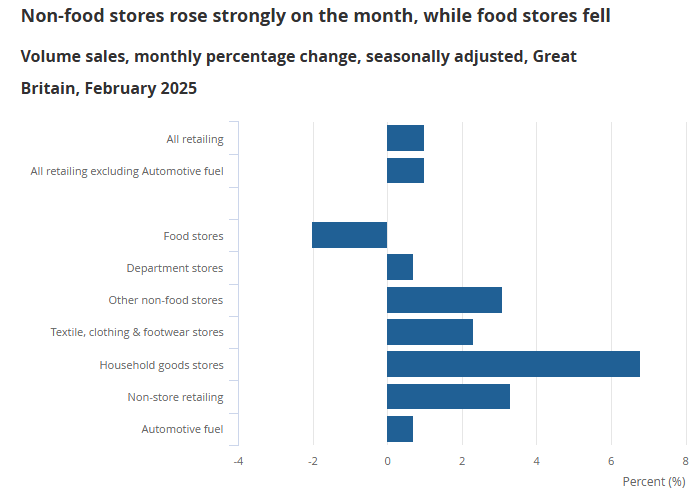
This graph show retail sales in the UK for February 2025. I think it is significant that the only sector to experience a fall is Food. But I don’t know what the significance is.

Office of National Statistics

There is no quick fix to make your Retail operation Buzz. There never has been. You have to earn your place on the High Street. It does not owe you anything. The consumer still likes to go shopping. You just need to make sure that your store is one of those they want to shop in.

Stop Press:

Forecasting…A Dark Art or is it now an Art lost in the Dark…?

Never having been a great fan of major organizations’ ability to forecast with any degree of reliability, what has happened within the last three to few weeks has surely thrown any forecasts into a very deep black hole.

When Donald Trump became President in January, the US stock market (followed by others) went through the roof. This was an administration that was very ‘pro’ business ( American business that is ). When the Administration started applying Tariffs, then postponing, then reinstating, then postponing, the markets did not like it and fell as did the Dollar, and US bonds tanked ( as they have done since early January).

None of this, is particularly, out of the ordinary. All new administrations, especially in the US, impact markets in various ways.

The uncertainty generated by President Trump’s promises to impose tariffs and carry out mass job cuts threaten the world economy’s soft landing after years of high inflation and interest rates, the Bank for International Settlements has warned.

But it is not all about the Macro effects. Only recently (17th March) the OECD cut their forecasts on growth in all of the G7 economies. How about us minions on the ground floor so to speak? The impacts are very difficult to estimate let alone forecast. One moment a nation is threatened with an enormous tariff rate only to be reversed 24 hours later , and then put back again. If you wanted to order 5000 thingymegigs, with a lead time of 6 weeks, do you order more now because they are about to be affected by a tariff in 8 weeks? Only then to find that the tariff is rescinded and you have to carry and pay for an excess stock of thingymegigs. Fortunately, it looks like thingymegigs will escape any tariff. Probably because they don’t want to make them in the States. The really stupid thing about this Tariff hammer to crack a nut, is that Trump keeps saying that the rest of the world has been taking the mick out of American business. If that were even true, then more fool American Business. He never mentions anything about the USA imprting loads of product that are made better by otehr nations.

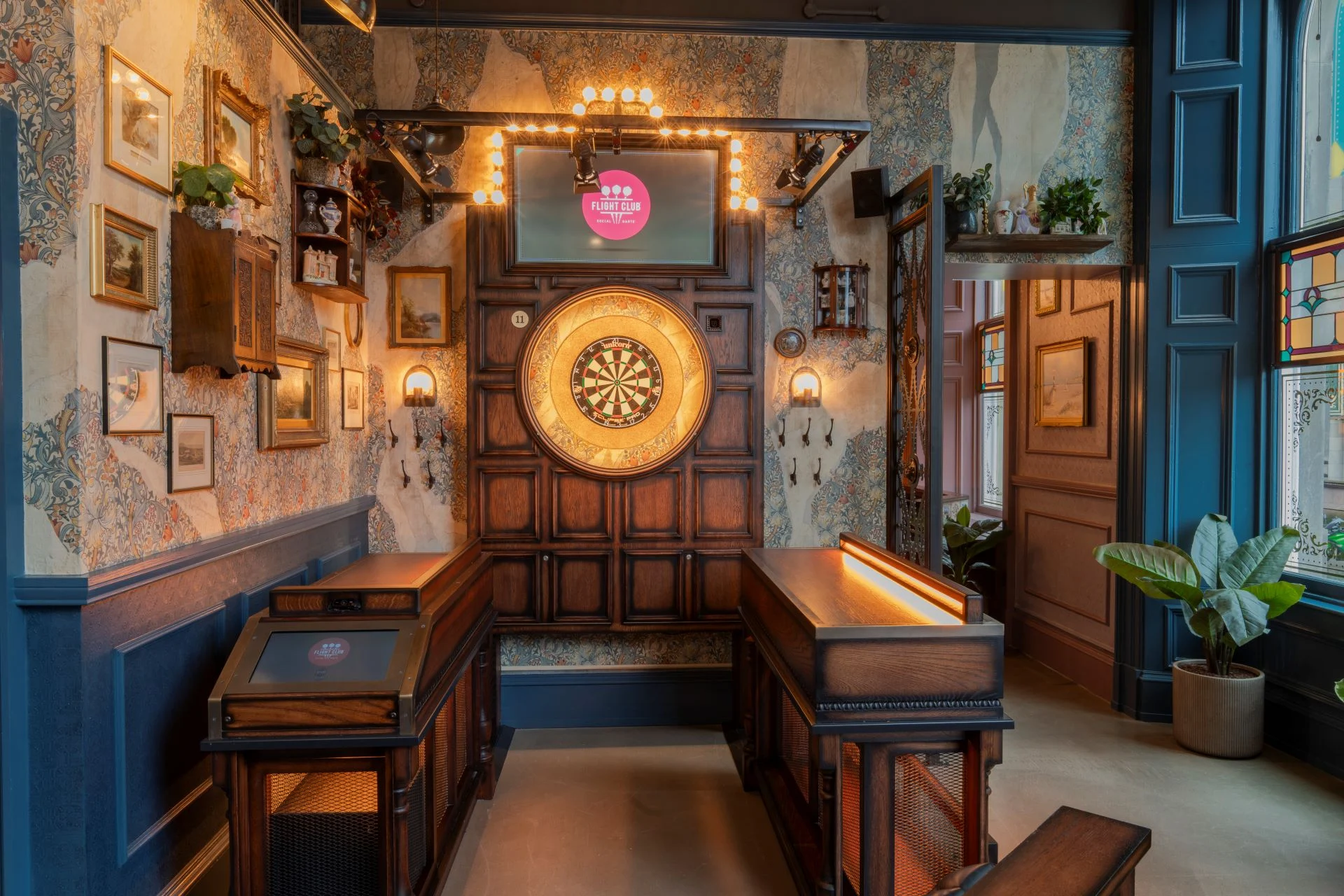
So what’s this got to do with the Minions(the rest of us)? The game of darts, in the UK, is enjoying a huge resurgence. This resurgence is, of course, creating a massive demand for Darts. What is one of the key components? – Tungsten. Speaking recently to a major online retailer of darts kit, they are clearly aware of product shortages which will get worse and more expensive. Could they have forecasted this three months ago? The increase in demand Yes, the supply issues No.

Where else is Tungsten used?

Darts, sort of miss out on the priority list. However, it illustrates how far down the chain these random and chaotic decisions go. Professional forecasters struggle to get it right at the best of times …

Now is not the best of times. Everything is up for change, and yet nobody really knows what this change is. Big or small, organizations have to forecast. You can only play the cards you have in front of you (using an analogy oft used by that well-known leader of the Western world). Whilst it is always good to have a Plan B, now it is critical. Therein lies another problem. Generally, when making a Plan B, you use judgement, information and data, plus a lot of ‘what ifs‘ to create the Plan. They have all been swept out the door.

This may not all be bad. Some good may come out of this. But once again, having not a clue as to what that good maybe, makes it very tough to create a strategy. Currently, any benefit you may see could likely be completely changed within a day, because of a reverse ferret in the direction of the bloke at the top.

The quote above makes no mention of Chaos.

And the OBR, like most economic forecasters, have a long history of getting things wrong.

As far back as 2012 it predicted that GDP growth in 2017 would be 2.8 per cent when in fact it was 1.7 per cent.

Likewise, in 2016 it predicted that the interest the government would pay on debt in 2020 would average 1.9 per cent when in fact it came in at 0.4 per cent.The Times March 2025

When you open your store on a Monday morning, there are some reasonable certainties that you can count on. You know what the rent will be. You know the wages you will have to pay. You will be aware of the power bills, your commercial insurances et al, and you will know what you want to sell. Each Monday, you maybe less certain of how much you will have to pay for your product, but when you know that you will know what you need to sell it for . If, of course, there are not any supply issues. You will have a pretty good idea who your ideal customer is .

That’s the stuff you do know . If you have a meeting with your friendly bank manager to increase your overdraft ( stupid suggestion as there no bank managers let alone friendly ones ) or are seeking a loan or investment, they will ask you to give them a forecast for the following quarter (or whatever).

So whilst the art of forecasting is very definitely dark, it remains a necessity. Currently, sticking a wet finger in the air and seeing which way the wind is blowing is probably as useful and accurate as anything.

Wind is my closing comment. For non Native English speakers, the slang for breaking personal wind is a Fart. Trump is a slightly more polite alternative. Trump is also the word used to denote the strongest suit when playing certain card games. Donald is very keen to talk about having all the cards. So, perhaps, we can now consider that the Art of forecasting is currently determined by the next Fart of the Trump.

I dont think we will have to wait long for the next Trump Fart.

Is there just a Glimmer….?

Investigating a murder and making economic forecasts both involve data and analysis. Murders involve analysing historic data , whereas economists analyse some historic but more importantly look at data going forwards. Crime investigators know for certain there is a perpetrator, economic analysts know nothing for certain.

At the beginning of every year, once journalists, commentators, and various types of financial fortune tellers, have finished throwing ale and wine down their necks and gorging on rich food, regurgitate forecasts, premonitions, propositions and outlooks for the year, as if it was something new and we should all look up and take note.

One of the sources for this post happens to be The Times Newspaper (U.K.). As with every January of a respective year, they provide share tips for 2025. They were conscientious enough to summarise their 2024 tips. If you had followed their analysis in January 2024 and invested £10,000, you would have lost £3,000.

At the outset, 2025 does not look great. 2024, for the most part was not good and there is little to suggest there is going to be any change soon.

So what are these ‘glimmers’.

Surveys of private sector companies show 70 per cent of firms expect higher turnover in the first three months of 2025, compared with a year earlier, and are confident in Labour’s attempts to boost the competitiveness of the economy through its policy promises.

In a recent survey, by The Times, of fifty-one economists, the majority said there would be at least 4 interest rate reductions in 2025. Within the last two weeks that has changed to 1, in the last 24 hours it became 2. How the ‘eck do you plan?

April 2025 will bring an increase in the minimum wage . Theorically this will put some additonal cash into the pockets of the lower paid.

With my focus being with the retail sector, that ‘glimmer‘ is somewhat ‘dimmer‘. It is still going to be tough both on the High Street and Online. The High Street is experiencing flat demand, rising costs, and they still believe online continues it’s world domination (back to that in a bit) . Online stores are burdened with increasing costs (very similar to bricks and mortar) increasing ‘unfair‘ competition from the likes of Temu, Shein and Alibaba. Unfair because the prices are often completely bonkers, the quality is sometimes poor but more importantly, they take advantage of extraordinary arcane shipping agreements which allow product to be shipped from China less than it would have been to send a Christmas card first class post in the UK. Much of the product has never been anywhere near a relevant product safety lab.

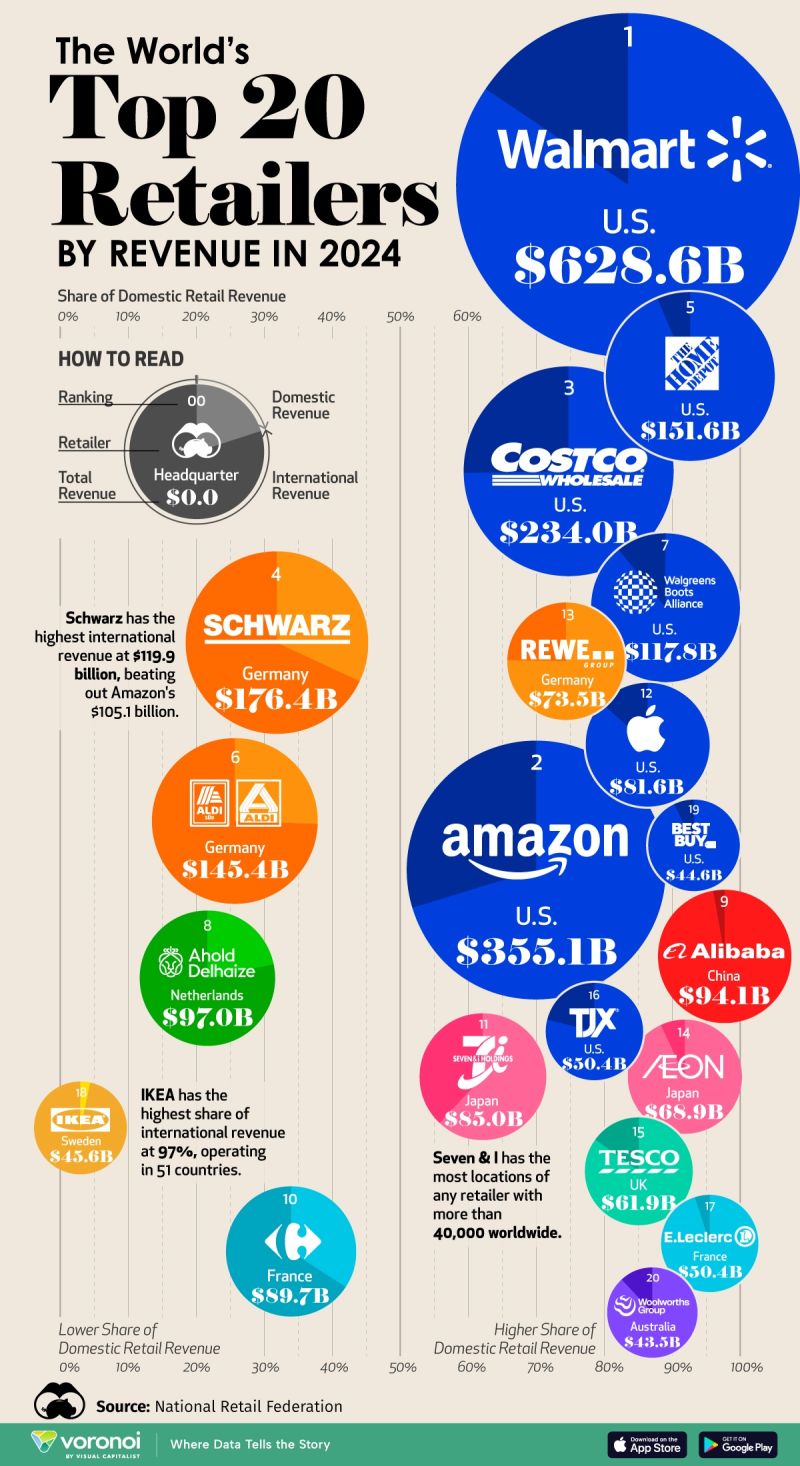
The image below displays the World’s top 20 Retailers. I think it is significant that the top 4 are Bricks and Mortar . Of course even these have signicant web sites but looking at the ratio of spend they would still be bigger than Amazon if you deducted their online ratio of approximately 20% .

In the UK the figure is nearer 30%. However, the sinificant figure is that this has changed only marginally in recent years apart from during Covid , when it peaked but dropped back . I think the US figure of 79% shopping online only represents 15% of their total spend (as illustrated above).

There are many reasons as to why online purchases are not powering ahead. One is quite simply the high cost to market. It is no longer a cheap option to sell your product. Assuming you wish to make a profit. Service, convenience and availability have become priorities for web shops of all sizes. All these cost money.

Whilst many economies are seeing the ‘cost of living crisis’ as having a significant impact on consumer spend many are overlooking that consumers are also altering their behavior in terms of disposable income. Recently, Julia and I visited a Travel EXhibition (B2C). It was heaving . The exhibitors were not about Sun, Beach and Sangria. The majority were selling experience trips. We are in a period of ‘experiences ‘. Glastonbury 2025 sold out in forty minutes (best part of £80 million spend minimum ticket price £375). Oasis tour sold out immediately. Throughout 2024 all the major tours such as Taylor Swift were sold out. Take a peak at the recent Darts World Championship. Every night of a 3-week tournament was virtually sold out (and nearly every attendee wearing fancy dress!). Who would have put money on that ten years ago?

A phrase I would love to have claimed my own but unfortunately I have seen it elsewhere and that is we are in an ‘Experience Economy’. The consumer is spending their disposable income in a completely different way. For an industry such as ours (party) it is difficult to adapt, but not completely impossible.

Three, fairly traditional, companies selling what are fairly niche products and one which was selling via retail stores, something that everybody thought only had a digital future , have just posted amazing numbers for the last 12 months . Hornby, a very traditional UK toy train maker , having suffered a number of torrid years has reported an 8% increase in sales and a corresponding profit forecast. The Games Workshop, a product I would have also considered very niche and limited to a tiny proportion of the population is now in the UK FTSE 100, posting massive profits of over £125 million for the last 6 months of 2024. Finally, Waterstones, the UK’s largest bricks and mortar seller of books have quadrupled their profits in 2024.

All three of these companies sell products that come out of the consumers’ very discretional disposable income. All of which you would have thought would have suffered during a period of rising costs and reduced disposable spending. Whilst having only tenuous links to the party market, the key commonality is that of targeting discretionary consumer spend. These three have found answers.

To top it all, we now have a newly elected leader of the free world ….so does Glimmer become Dimmer and Dimmer becomes dummer? Let’s stick with Glimmer. The free world leader says these are Golden Times. ‘Let’s go get some gold’. Is that positive enough?

It has been difficult finishing this post. Every single day over the last 2 weeks, at least, the goalposts have changed. One day the glimmer gets brighter, the following it gets dimmer. Inflation is steady, then it is not. Interest will come down, no they won’t, and yes they will. There is no growth, sorry there is a bit, oh we can see there will be a bit more? House prices are going up and down. How can anyone plan?

Murder detectives collect evidence. New evidence may appear and change the outcome. But that evidence is historical evidence. Those running businesses, and planning economies have and always have nothing really better than informed guesses based on historical data and what current data suggest may happen in the future. Currently, that informed bit is very unreliable and constantly changing. So is the data. The one common factor among Retailers of all types, and this is true for products and services, Success cannot be achieved without stock. The key is, then making it is the right to stock at the right price.

National Insurance Contributions …. Am I missing something ?

Being the season of goodwill and all that. Everybody is reading about :

  • 127 ways of roasting a turkey/goose/chicken
  • Why do the British put cream/custard/ice cream on meat pies (mince pies-for all Non Brits) ?
  • How to feed a family of four at Christmas for £1.78
  • Why a Local Vicar is telling small children that Father Christmas does not exist

I felt the need to write something completely inappropriate and what could be more inappropriate than National Insurance Contributions.

I try very hard not to say anything about politics, there are bucket loads of people who can do that for better or for worse . I am politically disenfranchised . I think those on the left, on the right and the centre have lost the plot . And not just in the UK .

Therefore, my question here is not aimed, in this case against the Labour party or their last budget , about which I have many other more pressing questions, but the effect it will have or not have on UK Businesses.

UK Business Plc is jumping up and down, screaming from the roof tops that it is sheer madness and will make prices will go through the roof or the entire economy will collapse over night. Whilst I dont’t think it will induce growth , and I think there are better ways to fill the black holes, if you drill down, I need to be illuminated as to why it will have such a detrimental impact on costs and then prices in the way that is being suggested .

A rise of 1.2% on a rate of 13.8% significant. The calculation I have found is that this will make a increase for an organisation employing somebody on the new minimum wage of £12.21 of approximately 0.4% . However, if you look at various data sources, the cost of labour to a UK business as a percentage varies between 15% -40% , very much dependant on the type of organisation . This would equate (even at 40% ) to the new NIC adding less than 0.2% to a company’s costs. The sort of increases facing companies on a daily basis make this pale into insignificance. Or relative insignificance. The increase in the minimum wage alone will have a much bigger impact on company costs. But not surprisingly that is not what the headlines are, as it is difficult to argue that increasing the lowest wage is a bad thing.

Here is an example:

This is not to pick on Morrisons, as I suspect other major chains have similar cost profiles. But it is very diffcult to imagine that a 1.2% increase in their labour costs would have a major impact on their performance, especially as some of this would be obviated by marginal price increases, all off which are the same for all their competitors. Moreover, in their case they are undergoing a cost cutting exercise including reducing their debt levels by 40%.

Shoe Zone, a UK retail chain of shoe shops are planning to close stores because of both NIC and Minimum Wage increases . It does not make sense. They state that their position in the market makes them very price sensitive . Well, its the same for theother discount shoe stores. And let’s remind ourselves this is the minimum wage not the National Living Wage.

The issues facing 2025 for the UK businesses ( and much of Europe) are general rising costs , very flat consumer demand, and political uncertainties. An argument over NIC is just the tip of an iceberg and enables Business to voice it’s concerns via a soft target. Some financial journalists are already saying the budget has already impacted on prices when none of them come into effect until April 2025.

Whilst I don’t see any economic growth with this budget there could be be grwoth in inflation due to the increase in NIC & Min Wage . Not terribly helpful as this will hinder and delay future interest rate cuts which would help growth.

If I have got this wrong , I would really like to know , otherwise Seasons Greetings ! And yes the last 2 images are AI generated – What fun we have …..Or is it what fun it has with us !

Design…..Why is it so difficult ?

I hate articles that start off with a Definition of something .

So, I will start with a really bland one, whilst defining the concept of Design does everything to make something that can be so complex , so very mundane.

It pervades nearly all aspects of our lives. It is most certainly pertinent in everything we buy, whether goods or services.

What makes good design ?

In the most part, this relates as well to a Service as to a Product.

Before we go any further lest not foget the wheel. 5,500 years and still going strong. I propose that there has been no better designed product. It has impacted upon every aspect of life and will continue to do so, in some form of other, for a long time to come . Nothing comes close in terms of design.

One simple product that I believe hits the mark on every count and illustrates the power of simplicity, usefulness, honest and long lasting is Laszlo Biro’s Ball point pen.

I can only think of one significant change in design and is when they put a hole in the top cap , to prevent small children (or big ones) from choking if they sucked on it and got stuck in the throat. Yes, very much a secondary use was the thinking process that was created when sucking on the top of Biro!

I stand correct on this as they have also managed to reduce the amount of plastic without impacting on design and use. See below:

I cannot come up with any equivalent low priced, effective succesful product which has been designed and as little changed over 75 years. There are many, however, corporate ‘designs’ that have stood the test of time with only subtle changes.

Clearly both of the above have changed but it has been very slow and evolutionary such as the principles of the original remain and as a generation of consumer grows that little bit older it can still connect to the brand.

Occasionally good product design can create a demand for a product that nobody really knew existed.

For me there is one stand out product of modern times. The process began with the Company name … Apple. At the time most other Computer Manufacturers had imposing names like IBM, ICL, Hitachi,NCL, NEC and Microsoft. Steve Jobs (nobody is absolutely sure why) plumbed for Apple. The machines looked different and they were the first with a graphical interface as opposed that of other systems using text. Their initial success was soon engulfed by the mass success of the licensing and creation of Microsoft and its use in most PCs worlwide whereas Apple software would work only on Apple machines,and somewhat ironically focused on the niche market of Designers. Having left and being brought back into the struggling company Steve Jobs did, what the market considered slightly bonkers, develop a product away from computers. First came the ipod, which was not only a stunning looking product but immensely practical because of its capabilities. In 2007 the first Iphone was launched to much acclaim for the way it looked but was crictised as many asked Whats the point of it?

Apple Inc created and designed The Point of it . Apple led and the rest has followed. They designed and created and product then designed and created a need for that product . Others followed . We are now at a point where in the developed market it has become a virtual essential to have a smart phone of one sort or another. Try and park your car without a smart phone . Try and book a Doctor’s appoinment with a smart phone. On a recent holiday in Italy, we went out on the first night for a meal, leaving our phones in the hotel as were on holiday, and on asking for a menu , being told to scan the QR code on the table . We didn’t do that again.

Very recently Jaguar (UK manufacturer -Indian owned -Car maker) redisgned their logo. It has been treated mainly with derision . The accompanying ad has no mention of cars. Elon Musk -New Leader of the Free World – or at very least the bit of the free world that is completely bonkers – says (and I quote)

Well, the proof of the pudding (as we say in English) will be in the eating . That said it has created an awful lot of publicity and it is very likley that someone like Elon Musk would not have even noticed the development without the controversial reviews.

The difference between Good or Bad in design , is subject to very fine margins. Ultimately, the judgement is made on how well a product or service performs. But it is not always true. Julia has a friend who often asks her what she thinks of the design of a new product she maybe launching . If Julia doesn’t like it then her friend knows it will sell . Well, some may say that Julia has no taste. To some that maybe very true, though they would be very brave to say that to her face. I would not say that. And that is not because I am worried about being smacked in the chops. It is because she has a very succesful background as a Designer .

In 1996, The architects of a new Building for Salford University (Manchester UK) received the Stirling Award for Architecture (supposedly the most prestigious architectural award in the UK ). For the last 9 years it has remained empty because it is unuseable. Bad ventilation , heating system that did not work, no kitchens or social spaces …..to paraphrase

Salford Council now wants to demolish the building to build 900 homes and the Architects are furious and are objecting. They base theri argument on…

It looked good but it was all form and no function .

In 1997 (clearly a bit of an iffy period in British Design) British Airways launched a newly design tail fin representing art and design from cultures world wide . The aim was to apeal to a market World wide . The, then, Prime Minister , Margaret Thatcher , when shown a model, dropped tissue paper over the tail fin. The designs were all removed in 2001 .

Several years ago a competitor of ours, launched a range of product, of which both Julia and I thought the design was really naff. We were wrong . Very Wrong. It turned out be a huge seller. Not only that, it was a product from a US company and they only sold it in the UK , making it unavailable in the US . Then they discovered that certain UK dealers were selling it on Amazon US with such a success that they made it available in North America.

Getting Design right should be a simple process. Well it is not . All the boxes maybe ticked, focus groups created, market research completed , but if launched and the customer don’t like it . The design ain’t no good . Design can be so simple, it is so important , it is very difficult ….For inspiration look at Bic and Apple . James Dyson (Dyson Vacuum cleaners) made 5,126 design changes over 4 years before his original idea worked. Even then he was rejected by many retailers. In 2023 the Turnover of Dyson was £7.1 billion . He got Design right. But nobody can tell him it was easy.