

Start Listening !

We are all guilty.

No matter how much we think we do, it’s never enough.

Wherever you are in the supply chain, no matter what market you are in, we don’t always listen to our customers or suppliers’ Of course this does not always relate to our commercial lives, it is, invariably, true of our personal relationships . However, whilst I can’t profess to be a specialist in any field I am most definitely not one when it comes to personal advice.

2023 is going to be a challenging year with many hurdles. We all need to be on top of our game which not only means listening to the level below i.e. the customer but also with the level above i.e. the supplier . We may not like what we hear . We may disagree with what we hear . The key is to hear what is being said and then to evaluate whether/what action is needed .

So it came as no surprise shortly after Christmas , The Times reported research (on New Year celebrations ) carried out by John Lewis from their website that searches for the word bunting were up by 40% and balloons by 140%. Whilst the John Lewis site does carry a few(about 10) of each item(most relate to birthday), if you look in most John Lewis stores you would be hard pushed to find any. Is that likely to change any time soon ? Probably not. But then John Lewis would not be a destination store for that type of product . But why then are they making a press release about it ?

Why, when they have a very similar target audience, are Wilko’s suffering, whilst Home & Bargain, B&M and Poundland are creaming it. May I suggest that they all have access to the same listening (consumer data) but it is how they have dealt with what they hear, that makes the ‘not’ inconsiderable difference.

It is not only about talking to your customers and hearing what they have to say , it’s talking to your suppliers , your competitors even. They may not always say what you want them to say, more often it is what they don’t say that is just as helpful. Visit Trade Exhibitions and see and hear what is happening within your industry. Read Trade Journals, albeit much of the content is very benign, nevertheless, I guarantee every so often there is something you would not already know.

There is a huge amount of data bombarding us on a daily basis. Much of it is just noise. But we cannot pretend it is not there, the skill is filtering the noise and to do this we need to listen.

There’s a lot of difference between listening and hearing

G.K.Chesterton

At a very recent trade show , I discovered, inadvertently that a product a customer of mine was seeking to import from the US was actually made 100 miles from him in the UK. He would no doubt have found out eventually, but it might have been a very expensive route. This came about from a very random conversation with an exhibitor who was displaying something very similar to the product my customer had told me about. An argument could be made that my customer should have found this out by listening. Can’t argue with that.

Another retailer being a little concerned about their poor level of business over the Christmas period and putting it down to general economic malaise, then discovered from other local traders that many of the locals in their area (it must be pointed out that the average consumer in this area is quite affluent and used to spending the summer in Tuscany!) had indeed decided to go away for an extended Christmas holiday.

True genius resides in the capacity for evaluation of uncertain, hazardous, and conflicting information

Winston Churchill

He doesn’t specifically talk about listening but that is what I take from the quote ( or at least in part).

42% of companies don’t survey their customers or collect feedback.

Hubspot Research

Ignore customers at your own peril

Back in the summer of 2011, Netflix ignored their customers by splitting its DVD and streaming businesses and effectively increasing prices by 40%. As a result, they lost a whopping 800,000 subscribers, their stock price fell to less than half its previous value, and the company became one of the 10 most hated companies in America.

Insider 2012

Not listening to your colleagues

The best example is from a Kodak engineer named Steven J. Sasson. He actually invented the first digital camera back in 1975. But his management did not take it seriously, it didn’t want to be associated with it. Kodak’s management failed to see digital photography as a disruptive technology because printed photos had been there for over 100 years, and who would want to see pictures on a television screen? At the same time, Kodak did not want to cannibalize its film roll business so it tried to keep the new technology under the radar.

Not listening to the consumer and the market place

BlackBerry believed too much in what they owned. The Customer experience is where BlackBerry turned out to be a laggard.

Both the above quotes come from http://www.togroundcontrol .com

The process of listening encompasses a whole gamut of activities. Be they visiting trade shows, attending conferences, speaking to friends, colleagues, customers , suppliers, associates , family, reading /listening to various media, being aware of what is happening on social media, especially, but not solely ,business sites like LinkedIn . There is a lot of guff in the latter two , but sometimes there are little gems .

There is an idiom in the English language “I’m all ears”. Not a great image as the guy below may testify but an imperative when trading in the current climate.

Big Ears, best friend of Noddy. For those who don’t know them, Shame on you -Google them! Big Ears listened to Noddy’s problems and helped him out a lot .

“Most of the successful people I’ve known are the ones who do more listening than talking.”

Bernard M. Baruch

There is one resource we all have in our Commercial Toolbox , the facility to listen. And it costs nothing. Not using it can cost an awful lot.

Do you eat too much Data?

Err Yes ….bit of a no brainier really. Or at very least it is for me. Only have to meet three people (data) ,and I would have forgotten the name of two within ten minutes . We are awash with it, data that is .

In any business we are constantly being told that the more information (for information read data , its the same thing) you obtain, the better you can operate your business. There is no doubt that there is an element of truth here, but only an element.

Ever since mankind decided it was jolly useful to write stuff down, we have collected data. How we used it depends on who you were or are. Historically the collection of data was rarely used for the general benefit of society. It was more about who or what you owned and just as important how you can increase your ownership and power structure. Many would say that little has changed.

Whatever the motivation data has become increasingly important to the point that it could argued that power wealth and data are inextricably linked . That said it can be argued that society has benefited from its use within areas such as health, education, technology and well being.

We are awash with it and half the time we don’t know what to do with it and the other half we think we do but we don’t really. I am not referring to those of us sat the bottom of the data strata, I am talking about the data giants, the Googles, Facebooks, Amazon et al. Here’s one of my favourites , or rather personal pet hates ( not ‘pet’ hates , as I love pets but ‘hates’ that I love the most ). The super companies who probably accrue more data together than the rest of the world intelligence services. I search for a new telly . I buy one. Meanwhile the cogs at google have been whizzing away saying that I am wildly interested in TV sets. and send me ads for the next six weeks. But I have bough one and you know that as well so what is the point in sucking loads of dosh from companies who are advertising to sell me one when I have already bough the bloody thing. Amazon admit to some sellers they struggle with the counterfeits as there is so much that goes through their market place. If they struggle what does any mortal company do about it.

Covid seems to be the perfect example of incremental amounts of data with bucket loads of organisations interpreting it all in widely different ways , leading to utter confusion and in many cases poorer decision making.

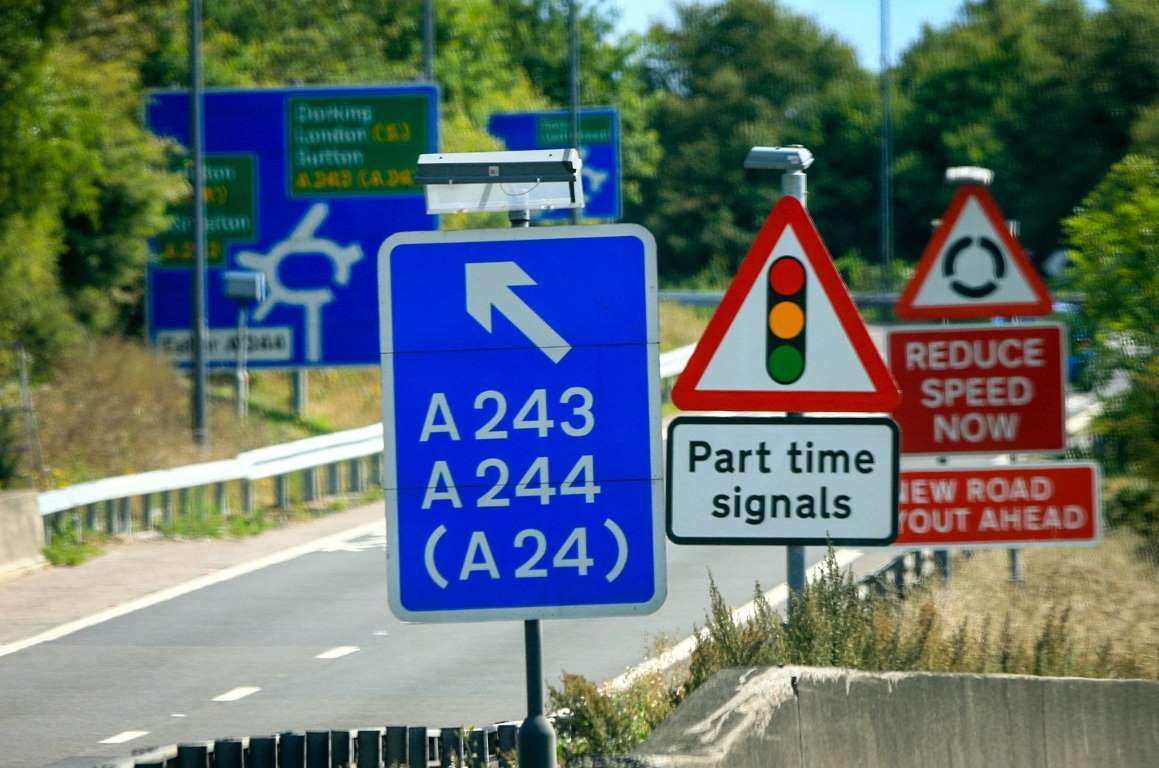
The above image replicates one of the more everyday, and simpler data overloads that many of us face everyday . Every item of data is most probably valid and legitimate but the method of portrayal, imagery and context is likely to lead to misunderstanding, poor decision making and ultimately much worse .

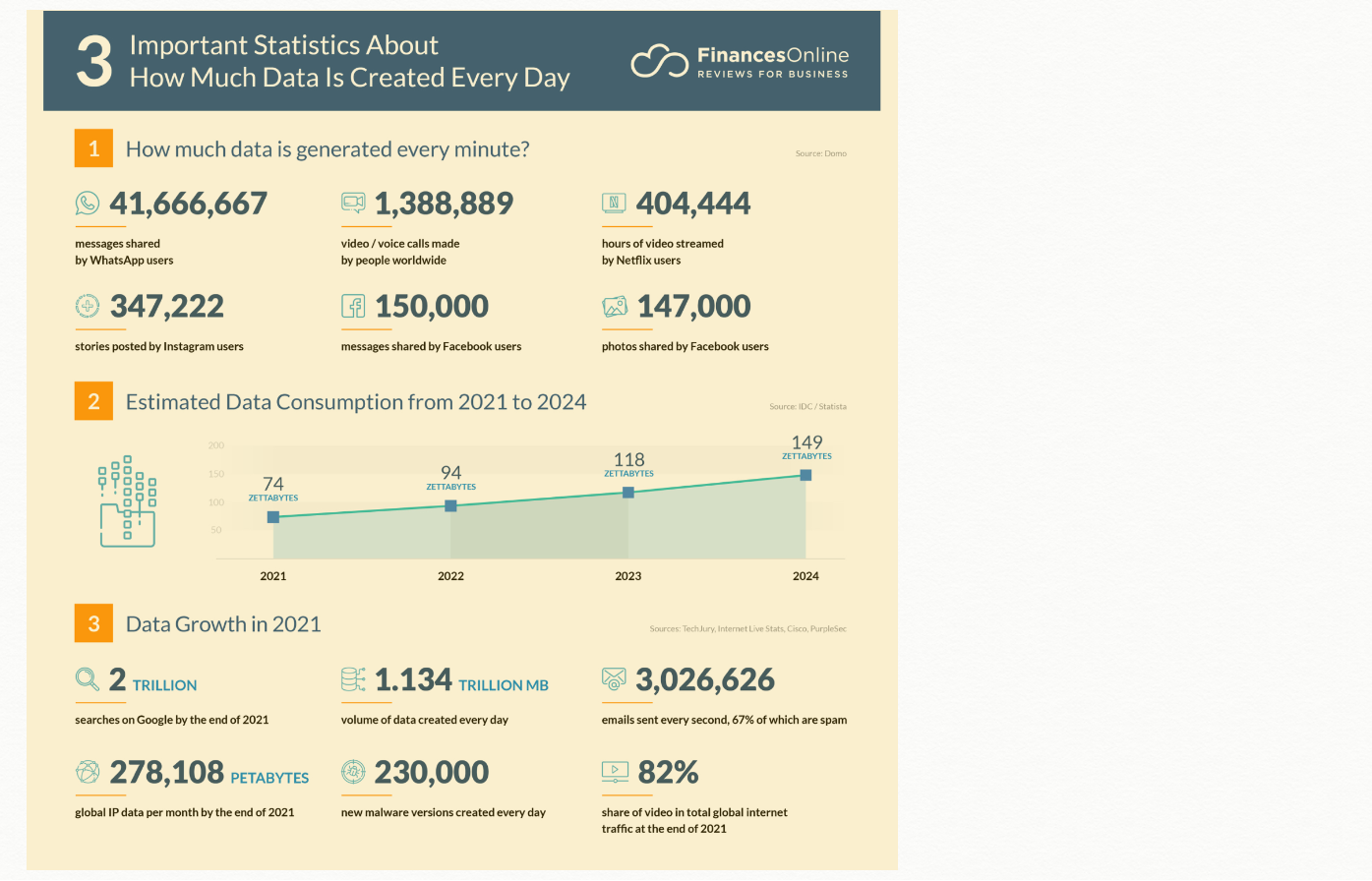
Some Completely Bonkers Data statistics

Here’s a very simple example I made up myself, which will seem obvious (that I made it up).

Man walks into jewellery shop and buys a very expensive piece . He does not speak to anyone or ask any questions , just takes it to the counter, pays for it then walks out .

That transaction is now a piece of data for that retailer. But what use is it ? What was the purpose of the purchase ?what is the customer profile ?

1. He bought it for his Wife

2. He bought it for his Mistress

3. He bought it for his Daughter

4. He is a cross dresser

The list is endless and without further data is really of no help to the retailer as to why certain purchases are made. Its very simple but by being very simple illustrates how very complex data can easily be misread if read at all.

Data accrues data. It feeds on itself . The more there is the more processes that are needed to make use of it and even to determine if its of any use. Worse still is bad data. The data on its own will not have any indicator that it is bad . It is its effect that makes it bad. Viruses are made from using bits of data albeit in a rather nasty way. Combatting bad data is more ‘good’ data.

In 2018 alone, the development of macOS malware tripled. As much as 250,000 new malicious programs are registered every single day, and there are grounds to assume this number will keep growing. A thorough analysis of scans performed by our users revealed that as much as 62% of Macs are infected with viruses (with an average of five infected files per user)

mackeepr.com

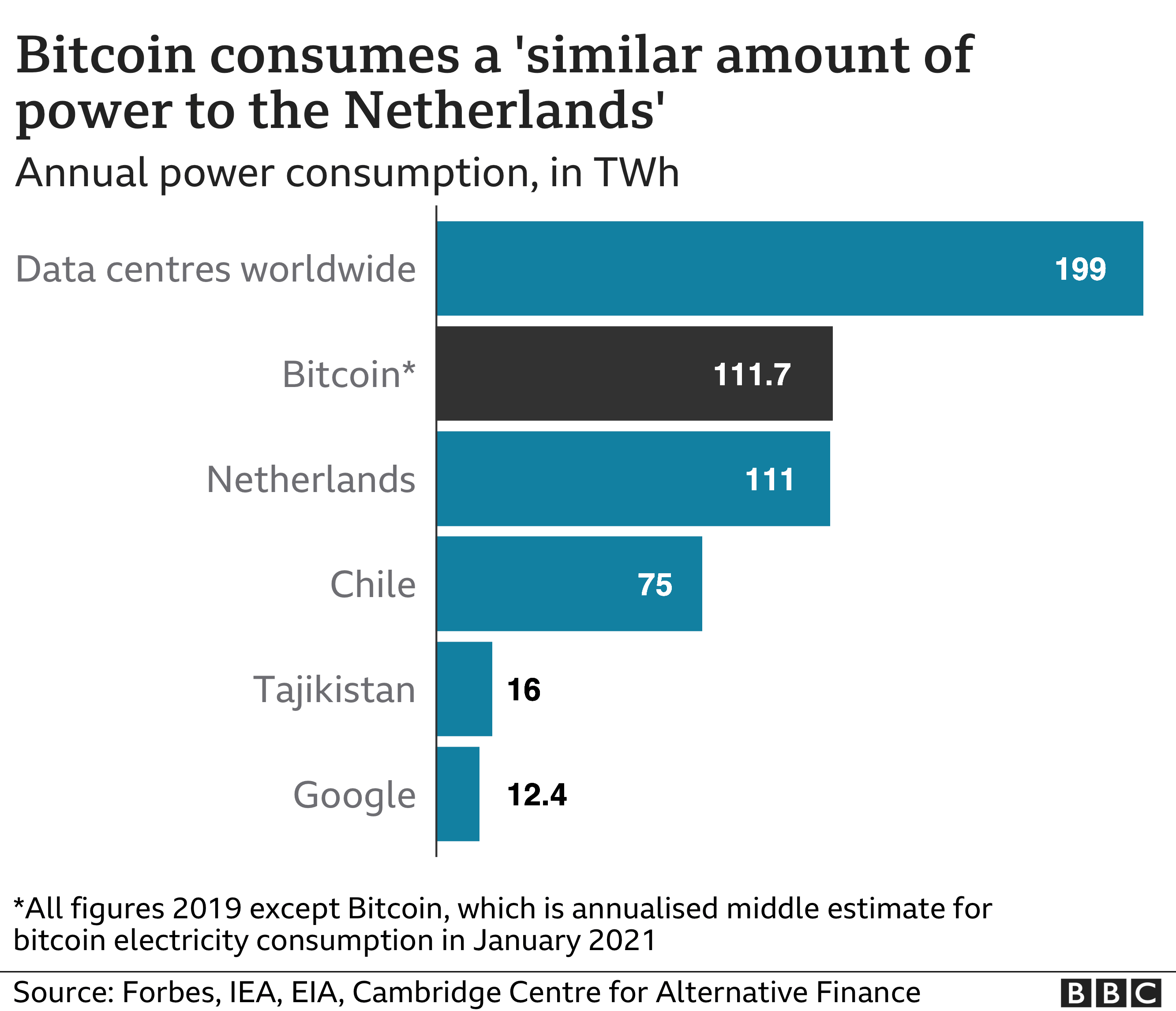
The flow is relentless and will only increase at an exponential rate . Mankind has becoming data obese. Obesity has many side effects . Data obesity has its own hunger and that is energy . It consumes vast quantities of energy . And this is only the beginning.

Bitcoin consumes a similar amount of power to the Netherlands

This suggests that whilst we may all be trying to reducing our energy consumption , data will be out there having an orgy of eating more energy . I am sure that tech guys will find ways of reducing this hungry beast, but they will need to ‘crunch’ a load more data to find the answers.

Most large organisations have CIO’s -Chief Information Officers who report to the CEO. They know the importance of data but whether they are able to really understand it remains to be seen . There have been too many events within the last 10-5 years when events that have occurred because previous data has been ignored or misinterpreted . The financial crisis for 2008 and many would say our current pandemic, are just two.

The obesity crisis in much of the West has been looming for some time (the data has been there). It can be resolved with education, government policy, time, and of course the will. I am not sure data obesity would be as easily solvable.

Data is crucial to every organisation and increasingly to the individual. What is overwhelmingly important is to the evaluation, sourcing, examination and decision making process involved with that analysis. Even within our own market place I have a seem an increasing number of players starting to use data analysis. My concern it is limited to what is happening today or yesterday but it is not very effective in determining what is likely to happen tomorrow .