
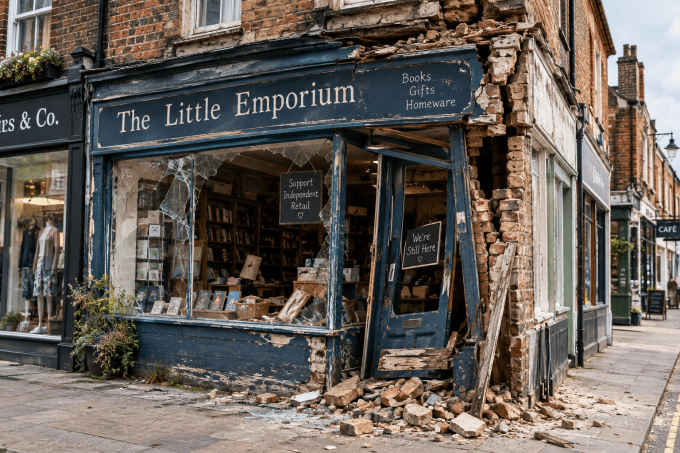
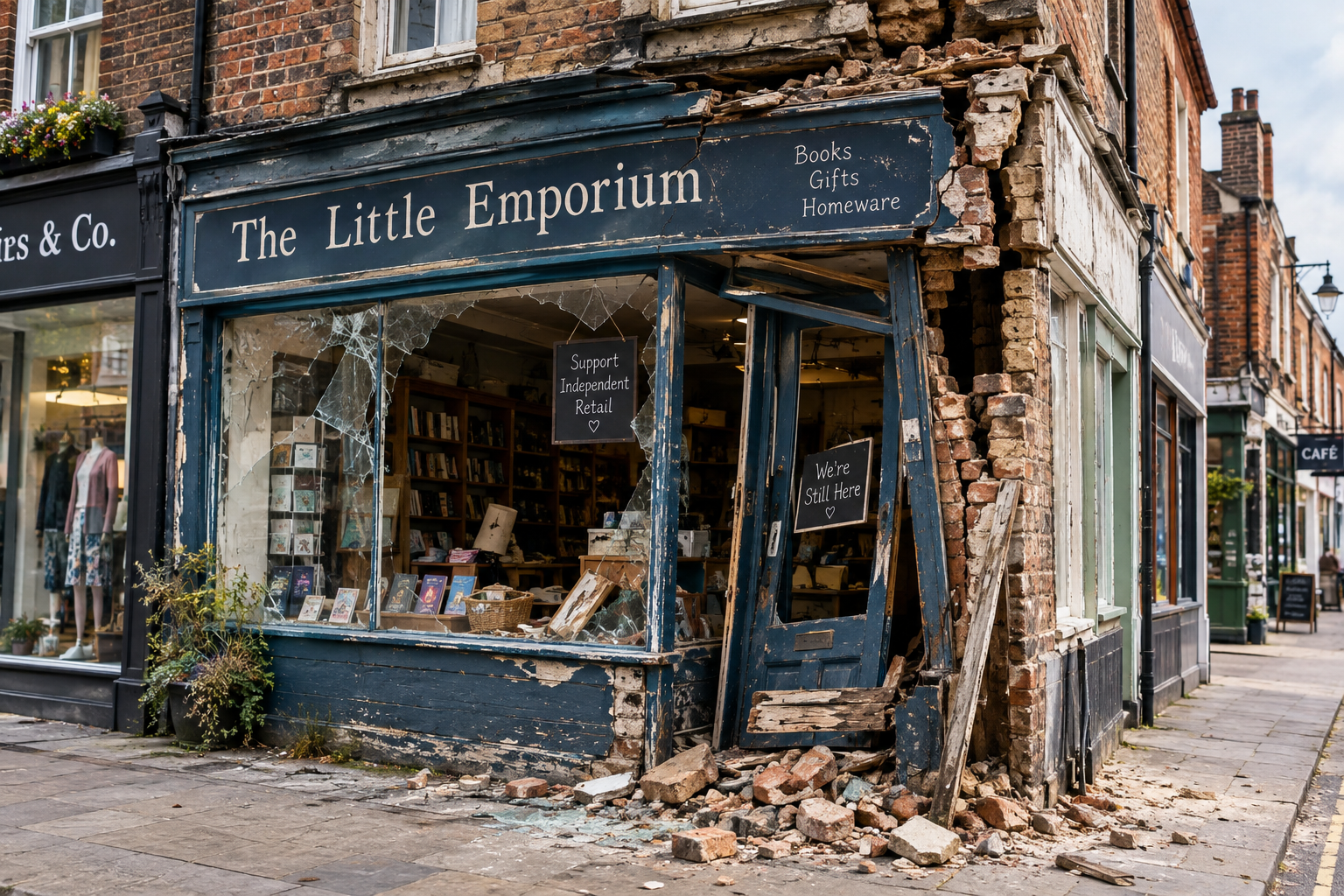
A day rarely passes where there is not some mention of the death of the UK High Street. Not only do I think it wrong, I feel it is very unhelpful. There is no question that it is very difficult but there have been many tough times in the past. If the only sources of information were traditional and social media , many would not be surprised to see town centres looking like this image, which is not real, it is AI.
Fortunately, the reality is somwehat different. What cannot be ignored are the core issues facing an Independant UK Retailer:
- High costs to employ
- Business Rates
- Business Rents
- Lower footfall
- There are some town centres/urban areas that are virtually, or a long way off repair. Either through lack of investment, poor local economy, social deprivation, weak employment. No amount of Retail ingenuity will create a vibrant retail environ. That is for another discussion.
- Changing nature of the High St
- Shoplifting
- Online- not quite so sure about this but comeback to later
- Just plain poor retailing
Apart from the last two, there is little over which the Individual Independant Retailer has any control. The UK High Street has changed and evolved over the last seventy years. First came supermarkets, then shoppping centres , followed by out of town malls and finally Online. All these and others have various effects and there is no going back. What is in the hands of the retailer is how they operate their businesses.
There are some myths that need to be debunked.
The High Street (independant retailers) store is dead or dying .…
Retail sales per occupied square foot reached a record £61.92 in the second quarter of 2026 up 23% from £50.39 in the final quarter of 2019……retailers are generating significantly more sales from the same amount of shop space ,even as online shopping remains important –The Times- Isabella Fish August 2026– Also in my last post
All the good retailers are closing down ….
The following examples are of some of the very succesful Independant Retailers from 2016-2026
Seasalt (Clothing)
It was doing around £34.6m in 2016. By the year ended January 2026, turnover was £148.3m. That’s an increase of roughly £114m, or 329%.
Oliver Bonas ( Housewares & Gifts)
Around 2016:
- turnover: about £50m
- stores: approximately 57
- profit before tax: around £4m
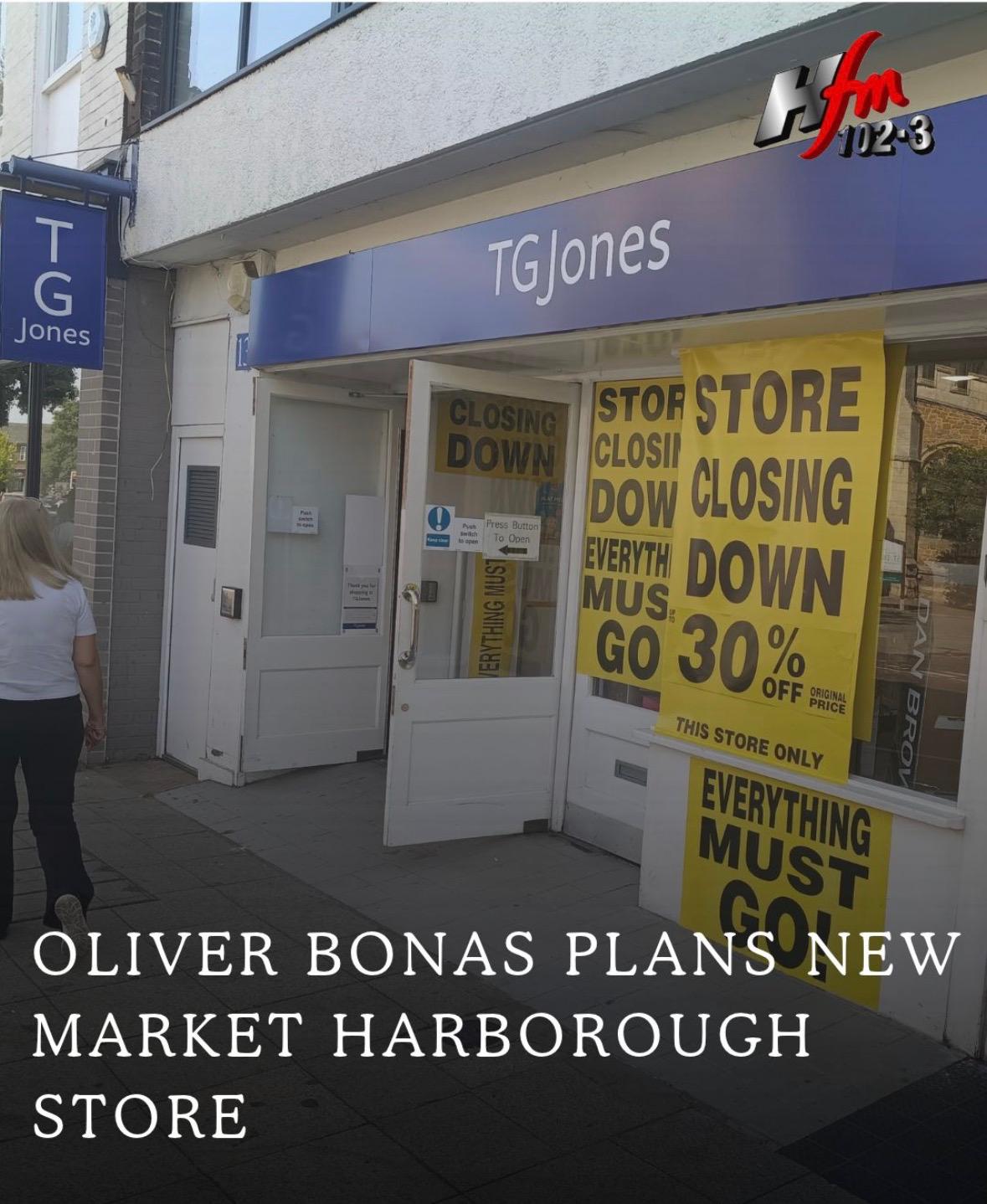
Latest reported 2025:
- turnover: £150.3m
- stores: 90 UK + 1 Ireland
- profit before tax: £7.9m
So turnover has roughly tripled, while the store estate has increased by about 60%.
Charles Tyrwhitt (Men’s Clothing)
The 2016-era figure was about £176m turnover, with profits of £4.6m. Retail Week
The latest reported year gives:
- £347m turnover
- £42.8m profit
- 43 UK stores
- 12 US stores
- around 40 franchise locations international
It’s not fair we (retailers) cannot compete with the Online Operators …. Their costs are much lower…
That is not the complete story. Some are lower, many are higher. Business rent and rates are likley to be higher becasue of location. However, frequently the premises of an online operation are much bigger. The High Street store will be higher per square foot but in total they will be a lot closer to each other. Whilst online operators do not suffer shrinkage from Shoplifting, they do from ‘false claims of product not being delivered’ ‘faulty returns- after being used’ and door step theft plus the odd dodgy delivery driver. Theft from Online deliveries are now estimated at approximately 2%.
The professional online operator will have a higher wages bill as they will be employing a more highly skilled back office( yes I know some outsource to places like India but they will still have skilled operators within the business).
The financing of stock will be generally be a much greater burden to the Onliners, if only because their offering will be much larger than the Store. Depending on the market; so for example a good independent fashion retailer may stock 5-6000 skus, ASOS stocks between 50-60,000 (Amazon Wordwide is around 600 million).
The costs to market and remaining there for an online operator are very high. With very few exceptions loyalty , without a lot of work is weak for Web Shops. The Independent shop name is always there. Once established with a good reputation and strong customer, the ongoing marketing costs should be relatively low.
Amazon is clearly the one operator that gets a lot of stick from retailers. In addition the new kids Temu and Shein(a decline of 14.3% in Europe in 2025) have a lot to answer for, but I suspect their following is and will be a lot more fluid than the likes of Amazon.
Many think of Amazon as just being huge warehouses but employing few. The truth is slightly different. Amazon UK employs approximately 75,000 full time employees at rates that often exceed those of other local businesses (Amazon claim that their starting salary for a fulltime worker is £31k) . I know this, as a couple of my customers are near an Amazon warehouse and struggle to get good staff as they cannot compete with the packages offered to employees by Amazon.
That is enough flag flying for Amazon (well not quite), which is not the intention. They are successful because for the first twenty years of its existence they reinvested everything back into the business. Part of the result was creating an extremely efficient and reliable retailer service to the consumer . Twenty years of Brand Building, and I think incomparable to any other retailer or indeed for any business.
Now the not so good side to Amazon .
The Seller’s Story
It is difficult to find out exactly how many Sellers there are on Amazon UK. A conservative figure is 25,000 plus. If they only employed 2 employees each (there are many single traders as there are many who employ many more) that accounts for another 50,000 jobs. However, life is very tough for many of the Sellers. They trade on Amazon as that is where the volume lies. And sometimes the volumes can be vast. It is estimated that there over 3000 UK Amazon sellers with turnovers in excess of £1 million. Amazon are a complete pain to deal with. Their costs are very high and there is extraordinary lack of interdepartmental communication. Many times I hear from customers saying there is no interdepartmental communication. When there are issues or problems, even ones that Amazon admit is their fault, can take months to rectify and often involves Amazon witholding large amounts of cash from the Seller.
Whereas Amazon is generally considered supreme in looking after their customers, it does a complete reverse ferret for the Sellers.
Last year I carried out an exercise on customers I had lost and who had ceased trading. Over a period of ten years 80% of those clients who had gone bankruptcy or ceased trading were Online sellers either generic sites, or Amazon and Ebay etc.
Retailers have to see Online operators as genuine competition. They should look at what the Online guys cannot offer such as personal service, professional knowledge and advice, the ability to see and touch product and possibly an experiential environment. Government intervention will be misplaced and of little help. Government policy has the tendency to be stuffeed full of unintended consequences.
There is a proportion of the population that greatly benefit from online operators and not just via pricing but because no High St retailer can offer the vast range of product that is often not even available on the High Street and there are large chunks of rural UK, plus the elderly and disabled who do not have easy access to any High St and the likes of Amazon ‘et al’ are their only access to this vast range of relevant products and services.
The High St has always had to adapt. In recent history, 100+ years ago it changed to meet the needs of motorized vehicles. In the early 1950’s it changed with the advent of the supermarket. Then came Superstores, Convenience Stores, Shopping Centres, Retail Parks, and finally Online in the early 2000’s. Yes, we have lost family ‘favourites’ ,Woolworths, Toys R US , C&A, MFI, Dixons, Mothercare, but where they that popular? I would say most had changed little and when the consumer was asked they would often say ‘I will miss xxxx I used to shop there but haven’t been in ages ‘ . ‘Used to’ being the operative words. Other retailers fail because their market disappears. For those of you old enough, Radio Rentals. What were they ? They rented TV sets. Blockbusters – they rented videos. Both long gone .Why? Because their market quite literally disappeared. You don’t see many blacksmiths on your High Street either.
Even when WH Smith decided to come off the High St ( having done very little to the chain in over 20 years ) the new Owners tried to come up with a name that reflected former times TG Jones. How original is that ? And why would you want to reflect ‘Old Times’. Inside the stores the offering was worse than that of WH Smith.
There are many good things happening and some Shopping Streets are looking seriously at how they operate and the need to create mixed retail environments including experiences and events .
Here is a snapshot from a web site dedicated to the High Street https://highstreetpositives.beehiiv.com/
Not all these refer to retail outlets but that only reflects todays needs.
🟢Oxford Street, London – Victoria’s Secret and POP MART have invested in major flagship stores, while the first phase of pedestrianisation has begun as part of a wider programme to reshape the area and improve the experience of the street.
🟢 London – WED2B is continuing to invest in physical retail, with its biggest-ever store opening at Royal Victoria Dock and a new High Street location in Holborn preparing to open. The expansion is creating around 60 new jobs and highlights the ongoing role of stores in delivering specialist experiences, expertise and customer connection.
🟢 Winchester & Bexleyheath – Accessorize and Waterstones are among retailers continuing to invest in town centre locations.
🟢 Middlesbrough – ASB Football Shirts has grown from a market stall into a high street shop, showing the journey local entrepreneurs can take.
🟢 Sunderland – Under The Ivy Flowers is creating a florist, workshop space and community hub focused on creativity, events and connection.
🟢 Carlisle – Coyote Joe’s is bringing a new country music venue and evening economy offer to the city centre.
🟢 Watford – Superdry is relocating into a larger flagship store at Harlequin, following strong trading performance at the centre. The move forms part of more than £30 million of tenant investment at Harlequin since 2024, highlighting continued retailer confidence and reinvestment in the destination.
🟢 Birmingham (Coventry Road) – Quids Inn is bringing a former Poundland unit back into use, creating a new bar and hospitality offer.
UK retail sales grew in October as colder weather encouraged shoppers to buy autumn and winter clothing, although online retailers continued to outperform the high street.
Like-for-like sales across fashion, lifestyle and homewares increased by 4.6 per cent year on year, according to the latest High Street Sales Tracker from accountancy firm BDO. This marked the strongest growth recorded since January 2025. (Retail Gazette)
Julia and I have travelled to most reasonably sized towns in the UK over the last fifteen years on business looking for new retail customers (party products market) . We encountered a number of really good retailers but the majority were quite poor. Bad presentation, lack of choice, lack of product on the shelves and very poor service. Nearly all of these have gone now. I am very sure, our industry is not alone.
Things are tough despite this I keep going back(not literally – I have never been) to Glastonbury . Tickets for 2027 sold out in under 40 minutes . 150,000 in total, at just shy of £380 each. And that is just to get in. The average spend for a Harry Styles concert, ticket, plus food and drink, travel, accomodation and merchandise £981 (Barclays Iportal), Taylor Swift £848 (vouchercodes.co.uk) .
Tough Yes, but money is being spent you just ‘gotta’ to find a way to grab some of that spend .
Punters prefer Shops ….Queues outside Retailers at Halloween ….
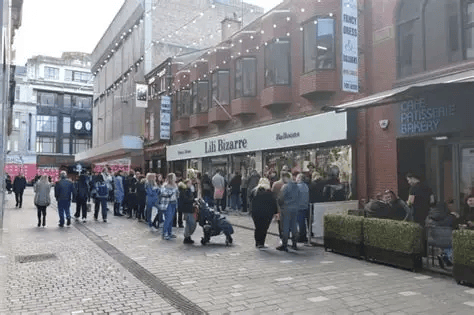
Liverpool
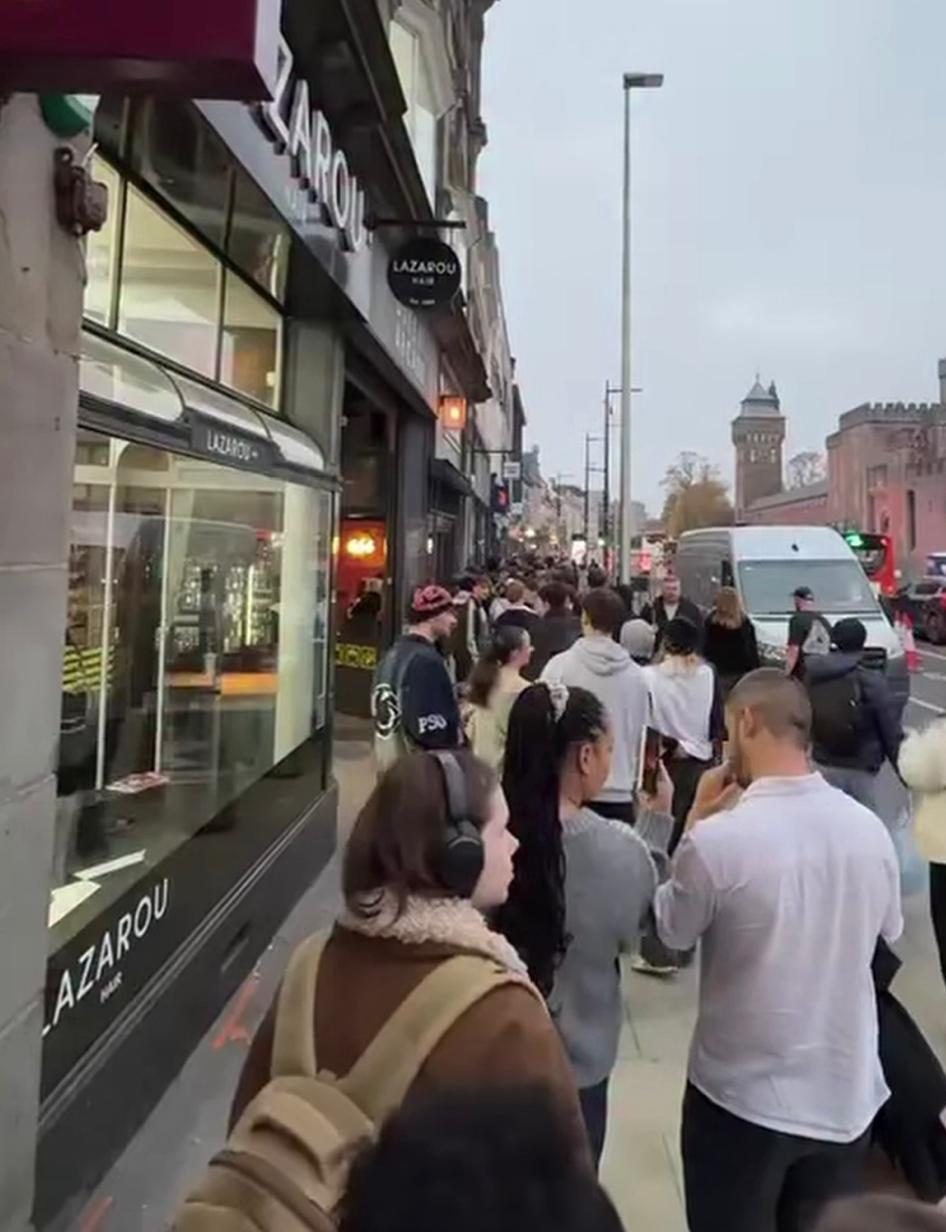
Cardiff
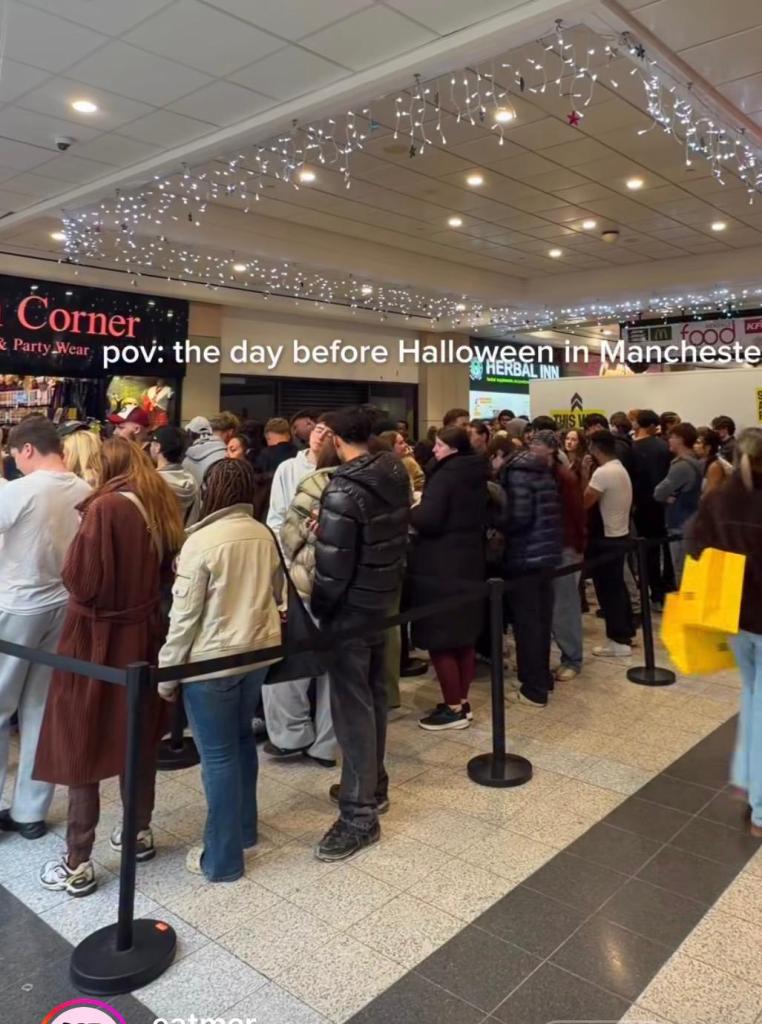
Manchester
…….footfall on Halloween (31 Oct 2026) rose +29% year-on-year, while week-on-week it delivered a +13% boost to High Street shopper traffic.
This builds on last year, when Halloween delivered a +4.6 percent rise in footfall versus the year prior and a +3 percent boost in weekly store visits, as it continues to grow and become a key spending event in the retail calendar. Retail Times November 2026

